
For wage garnishment, “disposable earnings” is a legal calculation, not simply another name for the net pay on your statement. Under the federal Consumer Credit Protection Act (CCPA), some deductions that reduce take-home pay do not reduce disposable earnings. Identify the type of garnishment before checking the calculation.
What counts as disposable earnings under the CCPA?
The Department of Labor's wage garnishment guide defines disposable earnings as earnings remaining after legally required deductions. Examples include applicable income taxes and the employee's Social Security and Medicare taxes. Voluntary deductions, such as union dues or insurance premiums, generally are not subtracted for this CCPA calculation.
Your final net pay can reflect additional deductions, including a garnishment itself. Do not use that final number as the starting point without asking payroll how the applicable calculation works. Our check stub reading guide helps identify gross pay, deduction lines, and net pay.
Example: $500 in earnings does not mean $500 is available for garnishment
Suppose a fictional payment has $500 in gross earnings and $80 in legally required deductions. For this simplified CCPA example, disposable earnings are $500 − $80 = $420.
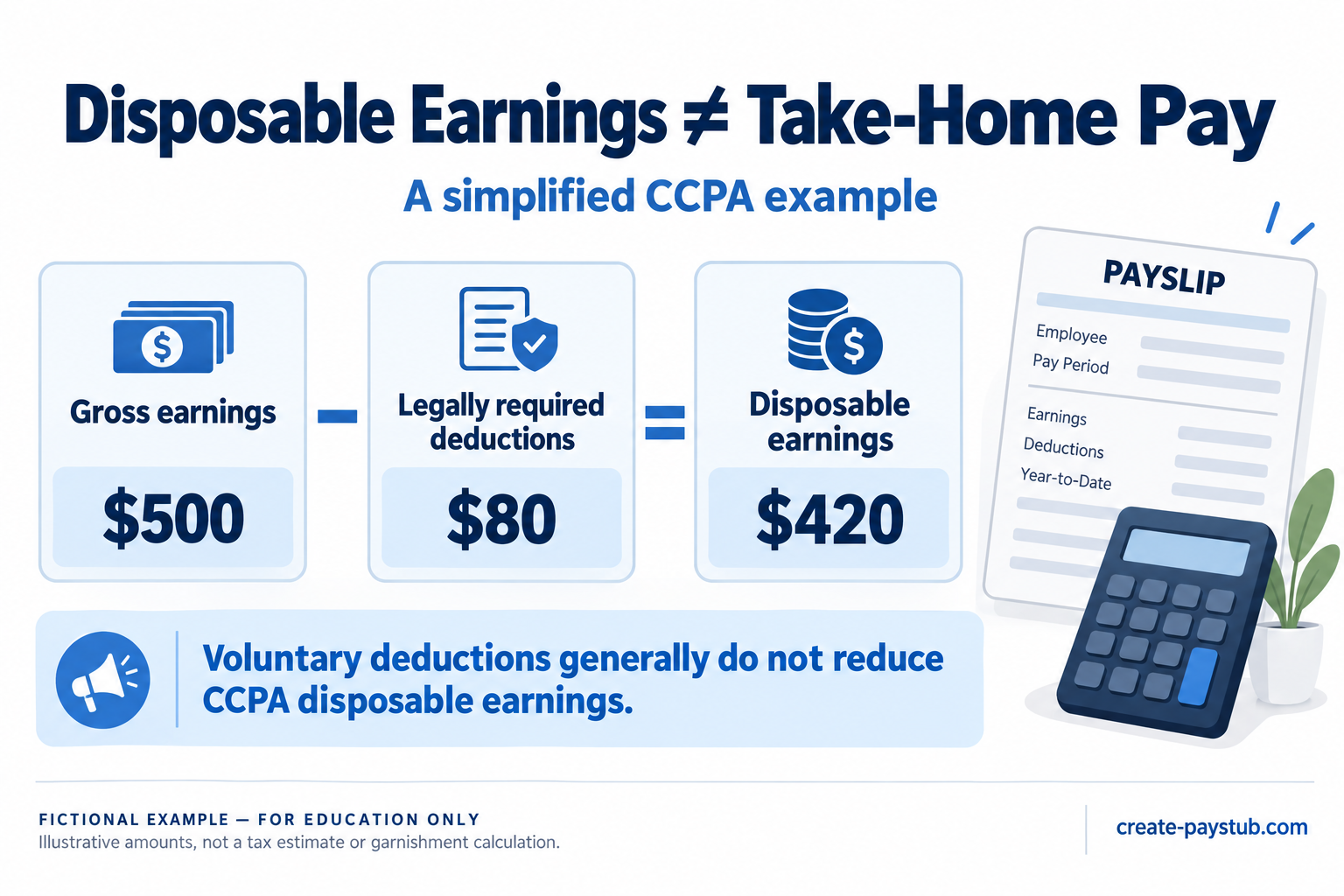
If a further $40 voluntary deduction applies, $420 − $40 = $380 would remain before any garnishment or other deductions in this illustration. That voluntary deduction would not change the $420 CCPA base. The $380 is not a final paycheck estimate, and neither figure states how much may legally be garnished.
The point of this example is to keep three questions separate: what you earned, which deductions belong in the applicable legal calculation, and what ultimately reaches you. A correct subtraction alone cannot confirm a correct garnishment.
Confirm the type of order before applying a formula
The DOL guide describes different treatment for support orders and exceptions for tax debts and certain bankruptcy orders. It also explains that a state rule providing a smaller garnishment can matter when compared with Title III. A single percentage copied from another person's paycheck is not enough to check your own withholding.
Definitions can differ too. For federal administrative wage garnishment of delinquent non-tax debt, the Treasury's individual FAQ includes health insurance premiums among deductions used to determine disposable pay. That differs from the general CCPA treatment described above. Confirm the governing procedure instead of applying this article's example to every order.
A practical checklist for reviewing the payroll entry
- Identify the entry. Ask payroll to explain an unfamiliar code and identify the order or notice it relates to.
- Match the payment. Compare the relevant pay period, pay date, and earnings. Keep the current deduction separate from the year-to-date total.
- Request the calculation base. Ask which earnings were included and which deductions were subtracted, with the reason for each.
- Request the withholding calculation. Ask how the applicable limit, pay frequency, other orders, and any relevant state protections were handled.
- Reconcile the statement. Check that the amount actually deducted matches payroll's explanation. Then compare net pay with the payment records.
If the bank deposit differs from the statement, first check for split deposits or separate payments using our direct deposit versus net pay guide. A deposit mismatch and a disputed garnishment calculation are different questions to investigate.
How to ask for a written breakdown
“My statement dated [date] shows a garnishment deduction of [amount]. Please identify the relevant order and explain the earnings base, deductions used to calculate disposable earnings or pay, and the calculation producing this withholding. Please also confirm whether other orders affected it.”
Keep the statement, notice, and reply together. If payroll identifies an error, request the correction date and supporting record; our pay stub correction checklist can help track the outcome.
A payroll explanation is not a decision about whether you owe the underlying debt. Read any notice promptly and follow its stated contact and response process if you dispute the debt or order. For federal administrative wage garnishment, the Treasury FAQ explains hearing rights and timing. This article is an educational record-checking guide, not a determination of your specific withholding limit.