
A $0 federal income tax withholding line does not automatically mean your paycheck is wrong. The payroll calculation can produce zero based on taxable wages, pay frequency, and the Form W-4 information being used. It also does not prove that you will owe no federal income tax for the year. Start by identifying the correct line, then check the payroll inputs and your broader tax situation.
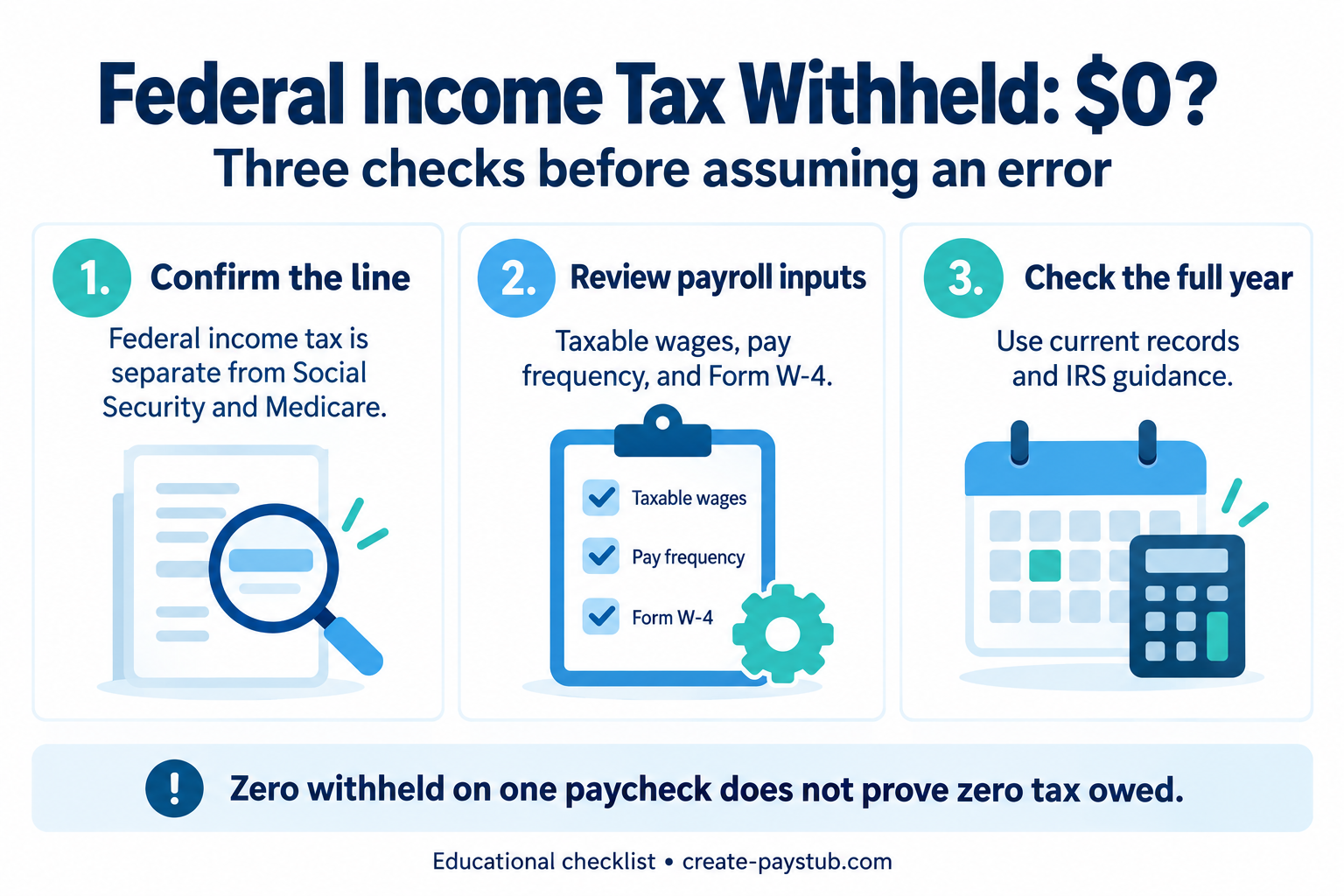
1. Confirm that you are looking at federal income tax
Read the label and ask payroll about unfamiliar abbreviations. A combined “taxes” total is not the same as the federal income tax line. Social Security, Medicare, and state withholding are separate categories. Our FIT versus FICA guide explains the distinction.
Compare the current-payment column with the year-to-date column. A fictional statement could show $0 federal income tax for the current payment and $420 withheld earlier in the year, leaving YTD withholding at $420. That example illustrates the columns only; it does not establish whether either amount is sufficient. See how to check YTD figures if the totals are unclear.
2. A payroll calculation can legitimately reach zero
IRS Publication 15-T provides the federal withholding methods. Its worksheets use wages, payroll frequency, filing status, and applicable W-4 entries. Credits can reduce calculated withholding to zero; additional withholding is then accounted for separately. A zero result is possible without an exemption claim.
Do not use a universal paycheck-size threshold found online. The applicable inputs matter. Ask payroll which taxable wage amount and pay frequency it used, especially if your hours, deductions, or payment schedule changed. The gross earnings number alone does not provide everything needed to reproduce the calculation.
3. Check the W-4 information actually on file
Compare your submitted election with the employer's current payroll settings. Confirm the filing status, multiple-job setting, credit amount, adjustments, and any exemption entry. Ask when your latest submission took effect instead of assuming the next statement already reflects it.
The 2026 Form W-4 instructions say that claiming exemption requires both no federal income tax liability in 2025 and an expectation of none in 2026. A refund alone does not establish that you meet those conditions. Use the form's full eligibility instructions before claiming exemption.
The same form addresses multiple jobs and a working spouse. Review those instructions if they apply; a withholding result for one job may not reflect your household's combined situation. Do not select “exempt” merely to increase take-home pay.
4. Gather records before reviewing the full year
Collect the latest statement, the previous statement, the W-4 confirmation available to you, and the relevant records for other jobs. Write down the payment dates, current federal withholding, and YTD federal withholding separately. Avoid substituting total taxes or your bank deposit for those fields.
The IRS Tax Withholding Estimator can help eligible users review withholding. Read its current eligibility and input instructions before using it. If your circumstances are outside the tool's scope, use the applicable IRS instructions or seek help from a qualified tax professional.
Review the result before submitting changes through your employer's normal payroll process. Keep the confirmation and check a later statement to see whether the employer applied the update. A larger withholding entry afterward is not, by itself, proof that the full-year amount is correct.
5. Ask payroll about the inputs, not just the zero
A specific question makes it easier to distinguish an expected calculation from a setup error:
“My statement dated [date] shows $0 current federal income tax withholding. Please confirm the taxable wages, pay frequency, W-4 settings, and effective date used for this payment, and explain whether those inputs produced the zero amount.”
If the settings differ from what you submitted, request a review and keep the original documents. Our pay stub correction checklist explains how to record the discrepancy and follow up. Payroll can explain its calculation; assessing your final tax liability requires the broader tax information.
Does $0 withheld mean I will owe money?
Not necessarily. Nor does it guarantee that nothing will be due. One statement records one payment's withholding, while your annual outcome depends on the full return. Treat an unexplained zero as a reason to check the records promptly, rather than a reason to assume either an error or a tax-free year.