
A 401(k) line on your pay stub usually records money directed from your pay into a workplace retirement plan. To understand its effect, first identify whether it is your pre-tax contribution, your Roth contribution, or a separate employer contribution. Then compare the current deduction with your election and the correct earnings base.
What should you look for in the deduction label?
Payroll codes vary. Look for a description such as 401(k), pre-tax retirement, or Roth 401(k), but ask payroll to confirm what its code means. A label containing “retirement” is not enough to establish the contribution's tax treatment.
Also identify whether a displayed amount is an employee deduction or employer information. Do not subtract an employer contribution from your take-home pay simply because it appears on the statement. Check how the system classifies the line and whether it is included in the employee deduction total.
Keep current and year-to-date columns separate. A $100 current deduction alongside a $1,200 year-to-date figure does not mean $1,300 was taken from this paycheck. Our pay stub reading guide explains how to follow those columns.
How do pre-tax and Roth contributions differ?
The IRS explains that employee pre-tax elective deferrals generally are not subject to federal income tax withholding when contributed, while employee Roth deferrals are. Both generally remain included in wages subject to Social Security and Medicare. See the IRS contribution withholding comparison.
A Roth 401(k) contribution is not the same account as a Roth IRA. The IRS's designated Roth account FAQ explains how Roth contributions work within a workplace plan. This guide focuses on reading employee payroll deductions, not choosing an investment strategy or describing every employer contribution rule.
A fictional $100 contribution example
Assume $2,000 of gross pay, a $100 employee contribution, and no other wage adjustments. For a pre-tax contribution, federal income-tax wages are $2,000 − $100 = $1,900. For a Roth contribution, those wages remain $2,000. Neither figure is the amount deposited in the employee's bank account.
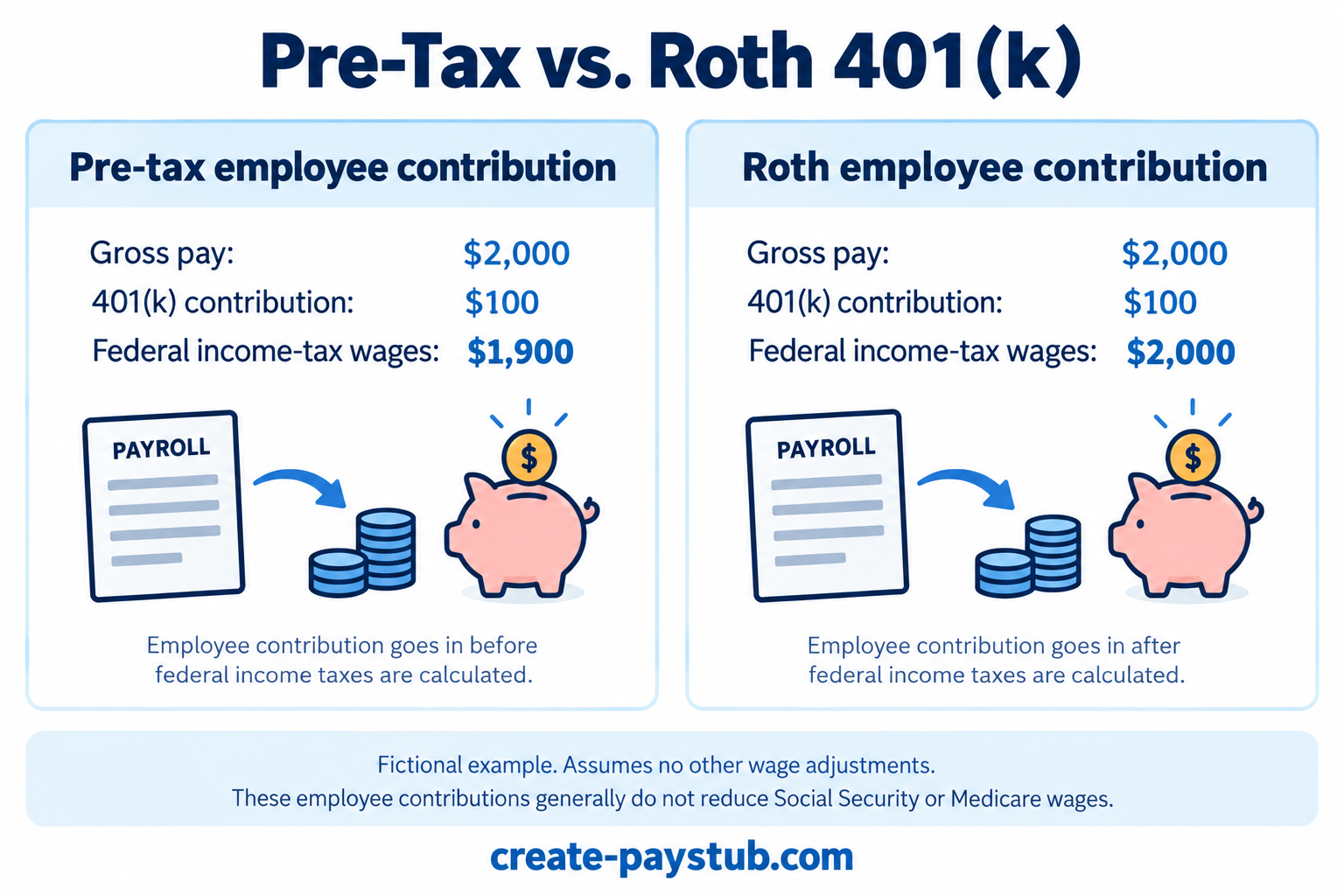
The contribution does not reduce Social Security or Medicare wages in this simplified example. Actual withholding also depends on the applicable rules and payroll details. See our FIT versus FICA guide if those tax lines are unfamiliar.
How can you check the deduction against your election?
- Confirm the effective date. Find when your latest election was supposed to start, then match it to the statement's pay period.
- Identify the election type. Check whether you selected a percentage, a fixed dollar amount, or separate pre-tax and Roth amounts.
- Confirm eligible compensation. Ask which earnings the plan uses for the percentage calculation. Do not assume every earnings code is included.
- Check the arithmetic. If the confirmed eligible earnings are $2,000 and the election is 5%, the illustrative contribution is $100.
- Compare the records. Review the current deduction and the corresponding transaction in the plan account, keeping their dates in mind.
A missing or unexpected amount needs an explanation rather than a guessed adjustment. Ask whether an election change, plan rule, contribution limit, or payroll correction affected it. Those are questions to investigate, not automatic explanations for a discrepancy.
What should you ask payroll or the plan administrator?
A focused request can say: “For the statement dated [date], I elected [percentage or amount] as [pre-tax or Roth]. The statement shows [amount]. Please confirm the effective date, eligible compensation used, and how this deduction corresponds to the plan transaction.”
If year-end wage figures are confusing, our guide to why W-2 wages can differ from pay stub gross pay explains why different wage totals need separate comparisons. Keep the election confirmation and original statements while a question is being resolved.
This article is a payroll reading guide. It does not recommend a contribution amount or determine which retirement account is suitable for you.