
“ER Health” on a pay stub often refers to an employer-paid health benefit or health-insurance contribution. “ER” is commonly used for employer, but payroll abbreviations are not universal. Confirm your employer’s code legend before deciding what the line means. If it is only the employer’s share of a health premium, it is usually shown for information and is not money taken from your paycheck. An “EE Health” or similar employee line may be the separate amount you pay through payroll.
The useful question is not just “What does ER stand for?” It is: Who paid this amount, where does it appear, and did it affect my net pay or taxable wages? This guide shows how to answer those questions using the pay statement, your benefits election, and payroll’s explanation.

What does “ER Health” mean on your pay stub?
Many payroll systems use “ER” to mark a cost paid by the employer and “EE” to mark an amount paid by the employee. Under that convention, “ER Health” can be the employer’s contribution toward medical coverage for the period. It may appear under employer benefits, employer contributions, or an informational section rather than under deductions. But employers choose their own short labels, and “Health” could refer to a different benefit in a particular system. Treat the code as a clue, not a definitive translation.
The employer-paid share is not normally cash handed to you, and a purely informational employer-cost line should not by itself reduce the net amount deposited. Some payroll statements show both the employer and employee costs to make the total benefit visible. Others show only the employee deduction. If a line appears among deductions or changes the net amount, ask payroll whether it is actually an employee charge, an adjustment, or a display of employer cost.
Do not confuse a health-insurance premium with an HSA contribution, a health FSA election, or a reimbursement arrangement. Those have different purposes and tax rules. Our HSA contribution guide explains why an employer HSA deposit is a separate item.
Employer-paid and employee-paid health costs are separate
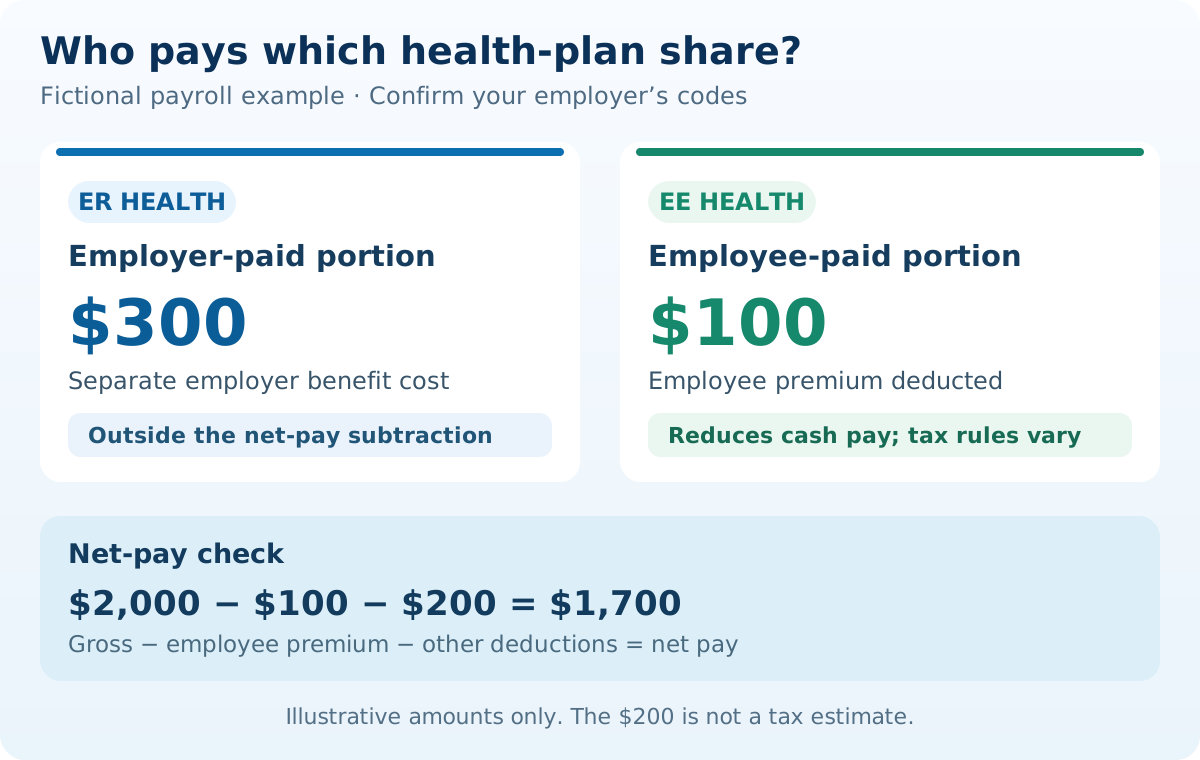
Suppose a fictional health plan costs $400 for one pay period, with $300 paid by the employer and $100 paid by the employee. A pay statement might label the first amount “ER Health” and the second “EE Health,” “Medical,” or “Health Premium.” In this example, the $300 is the employer’s cost; the $100 is the employee’s payroll contribution. The total plan cost does not mean $400 is deducted from the employee.
Check the benefit enrollment or payroll notice for the coverage tier and the employee contribution per pay period. If a pay stub shows a “current” and a “YTD” column, compare current with the amount expected for that payday; YTD is a cumulative total, not another deduction this period. Our YTD guide can help distinguish the two columns.
For a covered employer health plan, the plan’s summary documents describe benefits and operations. The U.S. Department of Labor explains the summary plan description (SPD) for ERISA-covered health plans. The SPD may not itself list your exact payroll deduction, so also use your enrollment confirmation and current payroll contribution schedule.
Does “ER Health” reduce take-home pay?
If payroll confirms that “ER Health” is only an employer-paid contribution, do not subtract it when reconciling your net pay. The employee-paid premium, taxes, and other actual deductions are different lines. Here is a fictional arithmetic example with all amounts specified; the $200 “other deductions” is a placeholder, not a tax estimate:
- Gross earnings: $2,000
- Employee health premium deducted: $100
- Other deductions shown: $200
- Net pay: $2,000 − $100 − $200 = $1,700
- Employer health contribution shown separately: $300, outside the net-pay subtraction
If your statement shows a different net-pay effect, do not force it into this example. Ask payroll whether the line is an offsetting accounting entry, an employee contribution, an adjustment for a prior period, or another benefit altogether. Compare the actual net pay with your bank deposit using our direct-deposit reconciliation guide.
Is the employer health amount taxable? How does W-2 Code DD relate?
In general, qualifying employer-provided accident or health coverage is excluded from an employee’s wages. The IRS Employer’s Tax Guide to Fringe Benefits describes the general exclusion and exceptions. That general rule does not prove the tax treatment of a line just because it says “ER Health”; confirm the benefit type and payroll setup.
An employee premium may be taken before certain taxes under a qualifying Section 125 cafeteria plan, or it may be taken after tax under a different arrangement. The IRS explains that a cafeteria plan can allow qualified benefits on a pre-tax basis. Do not infer “pre-tax” from “EE Health” alone. Ask whether the employee amount reduces federal income-tax wages, Social Security and Medicare wages, or neither under your plan.
At year end, Form W-2 Box 12, Code DD can report the cost of applicable employer-sponsored health coverage. The IRS says this is informational and does not make the coverage taxable. The reportable amount generally includes both employer-paid and employee-paid portions for the coverage being reported. It therefore may not equal the sum of “ER Health” lines alone, and reporting exceptions or coverage types can affect what appears. It is not another paycheck deduction.
How to verify the line on your own statement
- Find its section and sign. Is the code under employer contributions, employee deductions, or a separate information panel? Does it subtract from the current net-pay calculation?
- Check the pay period. Match the current amount to the correct payday and coverage start date. Do not compare a monthly premium directly with a biweekly amount without accounting for the schedule.
- Compare the enrollment record. Check the plan, coverage tier, dependents, and employee premium you elected. Your benefits portal or enrollment confirmation should identify the current plan.
- Ask payroll to decode the exact label. Request the name of the benefit, the employer-paid and employee-paid amounts, and whether either amount changes taxable wages.
- Reconcile the result. Verify net pay and, later, compare W-2 Code DD with the plan’s reportable coverage cost rather than assuming it is only the employer share.
Keep an original copy of the statement if you report a discrepancy. Our pay-stub correction checklist helps you make a specific request without altering the record.
Why might “ER Health” appear, disappear, or change?
A change can reflect a new plan year, a different coverage tier, adding or removing a dependent, a mid-period enrollment date, a change in the employer’s contribution, or a payroll correction. A missing line does not automatically mean your coverage ended; some statements simply do not display employer-paid benefit costs. Likewise, a displayed employer cost is not, by itself, proof that a claim will be covered or that enrollment is active on a particular date.
Compare the pay period with the effective date in your benefits records. If the amount changed unexpectedly, ask both payroll and the benefits administrator to explain the calculation. The plan’s insurer or administrator is the right source for coverage status and claim questions; payroll is the right source for the pay-stub entry.
Common questions about ER Health
Does ER Health mean I owe the amount shown?
Usually not if your employer confirms it is an employer-paid contribution. The location of the line and its effect on net pay matter more than the abbreviation alone. Ask payroll if the amount is listed as a deduction or bill.
Is ER Health the same as an HSA deposit?
Not necessarily. Health-plan premium costs and HSA contributions are different benefits with different records. Request the full code description if your stub is unclear.
Why does my W-2 Code DD amount differ from the ER Health YTD total?
Code DD generally reflects reportable coverage cost, often including both employer and employee portions, while an ER line may show only the employer share. Timing, plan type, and reporting rules can also differ. Ask payroll for the coverage-cost reconciliation before assuming an error.
What should I ask payroll?
“On my [pay date] statement, what does ‘ER Health’ represent? Is it employer-paid, employee-paid, or informational? Does it affect my net pay or taxable wages, and how does it relate to my elected health plan?” That question gives payroll the exact line and the practical issues to resolve.