
A wage garnishment can appear on a pay stub as a deduction with a payroll code, a current amount, and sometimes a year-to-date total. A label such as “GARN” may refer to garnishment, but there is no universal payroll-code dictionary. The label alone does not identify the creditor, prove the debt, or tell you which withholding rule applies.
Start with three records: the pay statement, the underlying order or notice, and payroll’s calculation. This U.S. guide explains how to connect them, check an ordinary-debt example, and distinguish a payroll error from a dispute about the debt itself.
How to identify a garnishment on your pay stub
Look in the employee-deductions section rather than assuming that every amount near “taxes” is a tax payment. The entry may use a short code, a fuller description, or a reference connected to an order. If it is unclear, ask payroll to translate that specific code; our deduction-code guide explains how to make that request.
Separate these figures before comparing statements:
- Current deduction: The amount taken for this payment. This is the figure to reconcile with current net pay.
- Year-to-date deduction: A cumulative figure within the statement’s reporting year. It is not automatically the full history of the case.
- Outstanding debt: A balance from the creditor, court, or collecting agency. It may account for interest, fees, payments elsewhere, or adjustments that a payroll total does not show.
A garnishment usually explains part of the difference between earnings and take-home pay. Do not add its YTD total to the current deductions, or subtract the same amount twice. Use the current columns and follow the pay-stub reading guide if the layout is unfamiliar.
The Department of Labor’s CCPA fact sheet describes garnishment as a legal or equitable process requiring earnings to be withheld for debt payment. Many garnishments involve court orders, but tax levies and some administrative procedures are different. A voluntary payroll payment arrangement should not automatically be treated as the same process.
Match the deduction to its source before checking a percentage
Ask payroll for the information identifying the order or notice behind the entry, and how to obtain a copy through the appropriate channel. The useful details are the issuing court or agency, case or account reference, debt type, date received, and instructions affecting this payment.
Compare the name and reference carefully with your own records. A familiar code does not rule out a wrong-person entry, a duplicate setup, or an old instruction applied to a new pay period. Keep personal identifiers and case records in secure channels rather than posting a complete statement publicly.
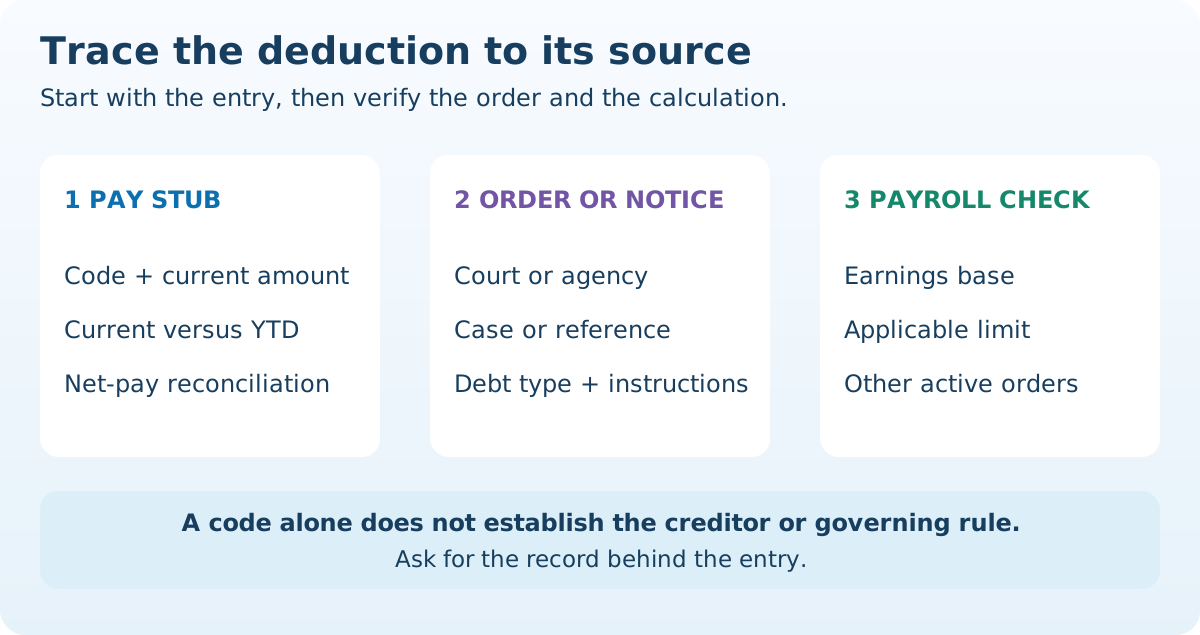
Request a breakdown that identifies the earnings included, legally required deductions used in the applicable base, pay frequency, amount requested, limit applied, and any other orders affecting the result. Payroll can explain its implementation; questions about whether you owe the debt or can obtain relief belong with the issuing body and appropriate legal assistance.
A weekly ordinary-debt example: the limit and net pay are different figures
This fictional example concerns a weekly cash-wage payment subject to an ordinary creditor garnishment. It assumes no other orders, no fees, no additional deductions, and no stricter applicable state protection. It does not describe support withholding, tax levies, bankruptcy orders, or agency-specific administrative withholding. The assumed tax amount is not a tax estimate.
Suppose gross wages are $640, legally required deductions are $80, and there is a $40 voluntary health-insurance deduction. For this limited CCPA example, disposable earnings are $640 − $80 = $560. The voluntary premium is not subtracted from that base. Our disposable earnings versus net pay guide explains the distinction and why definitions can differ across procedures.
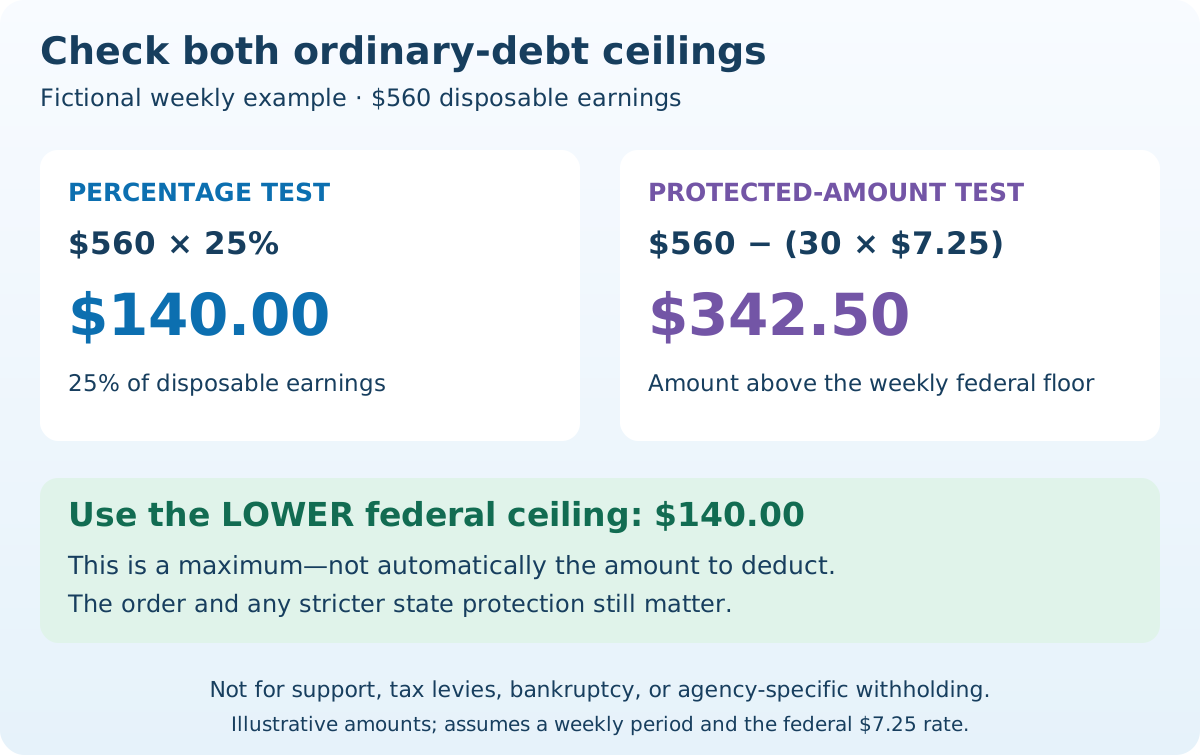
For ordinary garnishments, 15 U.S.C. § 1673 sets the general weekly federal ceiling at the smaller of 25% of disposable earnings or the amount above 30 times the federal minimum hourly wage. The DOL minimum-wage FAQ confirms the federal $7.25 rate used here.
Scroll horizontally on small screens to see every column.
| Check | Calculation | Amount |
|---|---|---|
| Disposable earnings | $640 − $80 | $560.00 |
| Percentage ceiling | $560 × 25% | $140.00 |
| Weekly federal protected amount | 30 × $7.25 | $217.50 |
| Excess above that amount | $560 − $217.50 | $342.50 |
| Lower federal ceiling | Smaller of $140 and $342.50 | $140.00 |
The result is a maximum under the stated federal test, not an instruction to deduct $140 from every payment. A smaller amount required by the order or a stricter applicable protection can change the deduction. If payroll correctly applies a $140 deduction in this particular example, final net pay is:
$640 − $80 − $40 − $140 = $380.
The three important numbers are therefore $560 disposable earnings, a $140 federal ceiling, and $380 final net pay under the additional assumptions. They answer different questions. A pay stub showing $380 net does not make $380 the base for the ordinary garnishment calculation.
Pay frequency matters. The law calls for equivalent limits for periods other than a week; do not use the $217.50 weekly amount unchanged for a biweekly, semimonthly, or monthly payment. Also do not assume that a higher state minimum wage automatically replaces the federal rate in this federal formula. Ask which separate state protections apply.
Why the same formula does not apply to every garnishment line
Identify the procedure before using the example:
- Ordinary creditor debt: The general federal calculation above is a ceiling, with applicable state protections and the order still needing review.
- Support withholding: Support orders have a separate federal framework under § 1673. Do not apply the ordinary 25% ceiling to a child-support or alimony entry.
- Federal tax levy: The IRS wage-levy guidance uses an exempt amount and Publication 1494. It is not the ordinary 25% calculation.
- Federal administrative non-tax debt: The Treasury’s administrative wage-garnishment FAQ describes a separate procedure, including its definition of disposable pay, notice, and hearing rights. That definition includes health-insurance premiums, unlike the general CCPA treatment in the example.
- Bankruptcy or state tax collection: The statute provides exceptions to the ordinary ceiling. The relevant order and procedure need their own review.
A code can be a useful clue, but a payroll shorthand does not replace this classification. Do not infer the type solely from the percentage deducted, either: a smaller order amount can coincidentally resemble another procedure’s limit.
Why might the amount change or appear on more than one line?
Changes can reflect earnings for the period, a different pay frequency, an additional order, an adjustment, or new instructions. If the deduction changes, compare the current gross earnings and calculation with the previous run rather than concluding that the debt balance increased by the same amount.
Where more than one order is involved, ask payroll to identify each one and explain the combined calculation. The general federal ceiling concerns aggregate disposable earnings; it is not a fresh 25% allowance for each ordinary order. Priority and interaction questions depend on the applicable orders and law, not just the sequence in which lines appear on the stub.
A year-to-date total is not a reliable payoff figure. Ask the collecting party for the current balance and ask payroll which amounts were withheld and remitted. If you paid the creditor directly or received a release, coordinate the records with the issuing body and payroll. Do not assume that a separate payment automatically updates payroll before the next run.
What to do about an unexpected or incorrect deduction
- Keep the original records. Save the statement, payment information, and any order or notice. Note the pay date and the specific entry questioned.
- Ask payroll to identify the source and calculation. Request the relevant reference, debt type, earnings base, applicable limit, and current amount.
- Separate a payroll error from a debt dispute. A duplicated line or wrong employee setup is different from disputing the underlying judgment, balance, or agency action.
- Follow the notice’s response process promptly. A payroll enquiry does not substitute for responding to a court or agency. The CFPB advises responding to a debt-collection lawsuit by the stated deadline and explains why ignoring it can lead to a default judgment.
- Track the outcome. If payroll finds an error, ask how and when the correction will affect the statement, payment, and remittance records. Use our pay-stub correction checklist.
You can write: “My statement dated [date] shows [code] with a current deduction of [amount]. Please identify the order or notice, explain the earnings base and withholding calculation, and confirm whether any other orders or adjustments affected it.”
If you need to dispute the debt, seek an exemption, or challenge the procedure, use the issuing court or agency’s instructions and consider qualified legal assistance. Payroll can explain a deduction but cannot resolve every legal issue behind it. If the bank deposit separately differs from net pay, investigate the payment using our direct-deposit reconciliation guide.
What employment protection does federal law provide?
15 U.S.C. § 1674 prohibits discharge because earnings are garnished for any one indebtedness. The relevant distinction is one debt, not simply the number of payroll lines or documents. Other laws or procedures may provide additional protections.
That rule is not a guarantee covering every employment situation. Keep relevant notices and employer communications, and contact the DOL Wage and Hour Division or appropriate legal assistance if you believe a garnishment-related protection was violated. This guide provides a way to review records; it does not decide the validity of your debt or your individual rights.
Frequently asked questions about garnishment on a pay stub
Does “GARN” always mean an ordinary creditor debt?
No. Employers choose their payroll labels. Ask which order or procedure the exact entry represents before applying a limit.
Is the YTD total the amount I still owe?
No. It is a cumulative payroll figure within its reporting scope. Obtain the current balance from the creditor or collecting body and reconcile it with payments and adjustments.
Can I ask payroll to stop the deduction?
You can ask for an explanation and correction of an error. Changing or ending an otherwise applicable order requires the appropriate process and instructions; a request to payroll alone does not settle the underlying matter.
Does a deduction shown prove the money reached the creditor?
No. The statement records the deduction. Ask for the remittance information and compare it with the collecting party’s account if a payment is missing.
Can making a new pay stub remove or change a garnishment?
No. A document should reflect the actual payroll transaction. Creating or editing a document does not change an order, establish payment, or resolve the debt.