
A payroll gross-up increases a payment’s gross wages so that the employee receives a specified net amount after the deductions covered by the arrangement. Instead of starting with a gross bonus and subtracting withholding, payroll starts with the promised take-home amount and calculates the larger taxable payment needed to reach it.
If your employer promises “a $750 bonus,” first ask whether that means $750 gross or $750 net after specified deductions. Those are different promises. A gross-up can help deliver the second one, but it does not make a taxable bonus tax-free or settle your final annual income tax.
What does “gross-up” mean in payroll?
Think of a gross-up as an agreement about the result of a payment. A normal gross bonus sets the earnings amount; the employee receives what remains after payroll deductions. A net-bonus arrangement sets a target remaining amount, and payroll works backward to find the earnings amount.
The scope matters. An employer might cover federal and state tax withholding on a cash award while leaving a retirement contribution or another deduction to the employee. Another agreement might target the amount deposited after all applicable deductions. Before comparing a statement with the promised amount, find out which meaning applies.
On an ordinary taxable cash bonus, the extra cash paid to cover withholding is itself part of the taxable payment. That is why simply adding the tax on the original target usually falls short. A gross-up also differs from an employer’s own payroll-tax expense: the employee’s earnings and withholding are the amounts used to reconcile take-home pay.
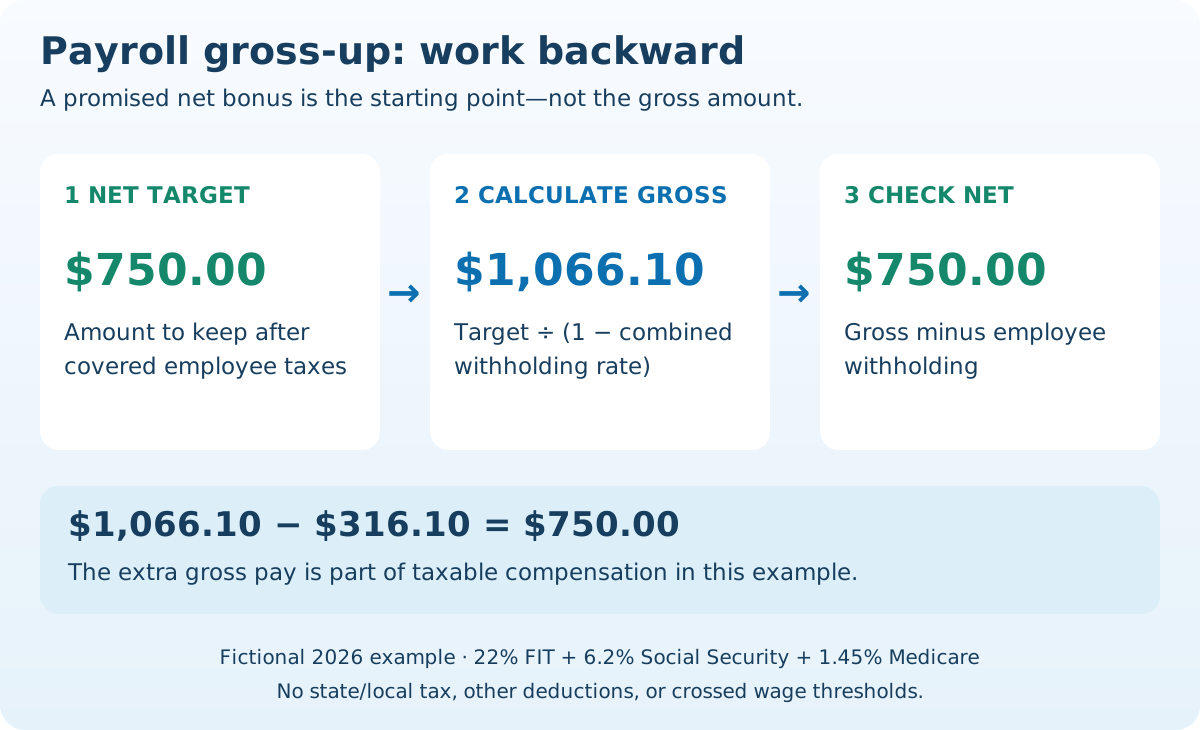
How do you calculate a payroll gross-up?
For a simple case in which all covered deductions are fixed percentages of the same gross amount:
Required gross payment = target net payment ÷ (1 − combined withholding rate).
Use decimals in the denominator. For example, 29.65% becomes 0.2965. The retained portion is 1 − 0.2965 = 0.7035, or 70.35% of gross. Dividing the target by that retained portion gives the gross amount before rounding.
The reasoning is: net = gross − (gross × rate), so net = gross × (1 − rate). If you multiply the target by 1 plus the rate instead, you only add withholding calculated on the target. Withholding also applies to the added taxable cash, so the result does not fully fund the promised net.
This is a model, not a universal paycheck calculator. Payroll must determine the applicable wage bases, withholding method, deductions, thresholds, and cent rounding. If those inputs change as gross pay increases, payroll may need to calculate and reconcile successive amounts rather than use one combined percentage.
A $750 net bonus: a complete 2026 example
Assume a fictional U.S. employee receives a separate taxable cash bonus with a $750 net target. This example is deliberately limited:
- The bonus qualifies for the optional 22% federal income-tax withholding method, and payroll elects that method.
- The entire payment is subject to employee Social Security tax at 6.2% and Medicare tax at 1.45%.
- The employee remains below both the 2026 Social Security wage base and the employer’s Additional Medicare withholding threshold after the payment.
- There is no state or local withholding, additional withholding, retirement deduction, garnishment, or other employee deduction. No regular paycheck is included in these figures.
The combined example rate is 22% + 6.2% + 1.45% = 29.65%. The calculation is:
$750 ÷ 0.7035 = $1,066.098… → $1,066.10 gross.
Scroll horizontally on small screens to see every column.
| Pay-stub component | Calculation | Amount |
|---|---|---|
| Gross bonus | $750 ÷ (1 − 0.2965), rounded | $1,066.10 |
| Federal income tax withheld | $1,066.10 × 22% | $234.54 |
| Employee Social Security | $1,066.10 × 6.2% | $66.10 |
| Employee Medicare | $1,066.10 × 1.45% | $15.46 |
| Total employee withholding | $234.54 + $66.10 + $15.46 | $316.10 |
| Net cash bonus | $1,066.10 − $316.10 | $750.00 |
The extra gross amount above the net target is $316.10. It is included within the $1,066.10 earnings total; it is not another $316.10 to add to that total. The employer’s own payroll taxes are separate costs and are not included in this employee withholding table.
For the federal method, 2026 IRS Publication 15, section 7 permits optional 22% withholding on separately identified supplemental wages within the $1 million limit when federal income tax was withheld from regular wages in the current or immediately preceding calendar year. An aggregate method is another option. Thus, 22% is an assumption here, not a rate every employer must use for every bonus.
The Social Security Administration’s contribution and benefit base page confirms the 2026 $184,500 wage base and the employee rates used above. For a simpler explanation of the separate tax lines, see FIT versus FICA on a pay stub.
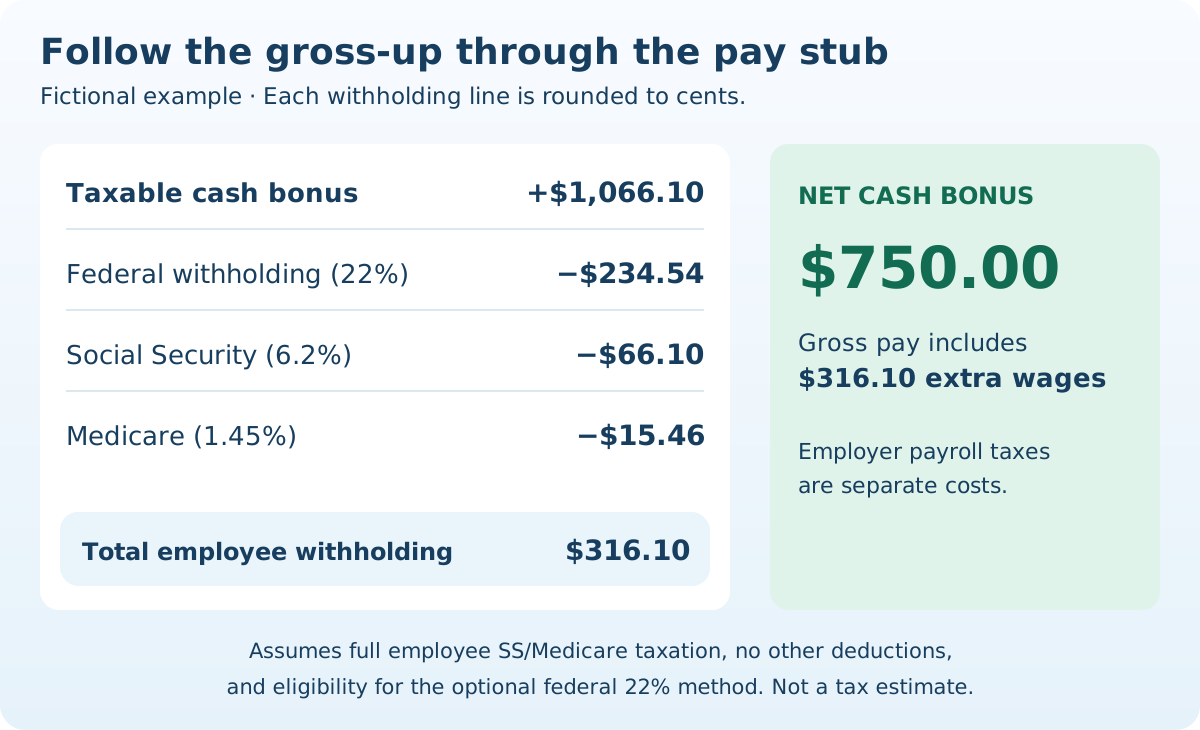
How does a gross-up appear on a pay stub?
Payroll might show one grossed-up bonus line or separate entries for the original award and the additional taxable cash. Labels vary. To check the result, follow the amounts rather than expecting one particular code.
- Locate the current earnings. In the example, either one line of $1,066.10 or two lines totaling that amount would explain the gross cash bonus. Do not count the gross-up twice.
- Identify the deductions attached to the payment. The example has three employee tax lines totaling $316.10. Actual statements can have more.
- Reconcile net pay. For a separate bonus payment, subtract the employee deductions from that payment’s gross. If regular wages are paid together with the bonus, request a breakdown instead of comparing the full deposit with the bonus target.
- Check what was paid. A net amount can be distributed across bank accounts or payment methods. Our guide to direct deposit versus net pay explains that final reconciliation.
Use current figures for this payment. A year-to-date bonus total may include earlier awards, and it will not necessarily match a single bonus notice. Employer contribution totals should not be subtracted merely because they appear near employee deductions.
Why can your gross-up differ from the example?
A wage threshold can split the payment. The 2026 Social Security wage base is $184,500. If only part of the grossed-up payment falls below that limit with the employer, applying 6.2% to the entire amount would misstate that line. Payroll must account for the remaining taxable wages; see why Social Security withholding can stop during the year.
Additional Medicare withholding can start mid-payment. The IRS Additional Medicare Tax guidance requires employer withholding of an additional 0.9% on wages it pays above $200,000 in a calendar year. That payroll threshold is separate from the filing-status thresholds used for final tax liability. A payment crossing it cannot be treated as if one extra rate applies to every dollar.
Other deductions can change the target. State or local withholding, benefit contributions, or an employee’s requested extra federal withholding may affect the result. A deduction may use a different wage base, a fixed dollar amount, or a limit. Ask whether the net promise covers it before adding percentages together.
The federal method can be different. An aggregate withholding calculation will not necessarily behave like one flat rate. Publication 15 also requires 37% federal withholding on the portion of supplemental wages above $1 million, subject to its aggregation rules.
Cash and noncash arrangements need different reconciliations. If payroll is covering tax on a noncash benefit, the taxable value may be recorded without an equivalent cash deposit. Do not use this standalone cash-bonus table to infer the deposit for an award, benefit, or reimbursement with a different tax treatment.
Does a gross-up remove the employee’s final tax bill?
No. A net-payment arrangement concerns payroll withholding and the agreed payment. Your final income tax depends on your annual income, deductions, credits, filing circumstances, and tax payments. Receiving the target deposit does not guarantee that you will owe nothing when you file.
The taxable earnings and withheld taxes still belong in the appropriate payroll and year-end records. Keep the bonus notice with the statement so you can distinguish a one-time grossed-up payment from recurring salary. Do not expect the W-2 to show only the $750 deposited as the taxable amount for the example.
A large award is a reason to review annual withholding. The IRS Tax Withholding Estimator can help eligible employees assess withholding using their broader financial information. It does not turn the limited example above into a personal tax calculation. Our bonus-paycheck guide explains the distinction between gross bonus, withholding, and take-home pay.
What should you ask payroll to verify?
Gather the written award terms, the original pay statement, and the payment date. Then ask:
- Was the promised amount gross, net after named taxes, or net after all deductions?
- Which earnings entries represent the award and the additional taxable cash?
- Which withholding method, wage bases, and year-to-date thresholds were used?
- Were retirement contributions or other deductions included in the net target?
- If the bonus was combined with salary, can payroll separate the bonus calculation from regular pay?
- Does the payment reconcile after rounding, and is a correction needed?
A clear request is: “My award notice promises [amount] after [specified deductions]. Please show the gross-up earnings, the covered withholding, and the reconciliation to that target for the payment dated [date].” If the explanation reveals an error, follow our pay-stub correction checklist and retain the original record.
Frequently asked questions about payroll gross-ups
Is a gross-up an extra bonus?
It is extra gross compensation used to fund the covered deductions. Under the example’s agreement, it delivers the $750 target rather than an additional $316.10 net payment. The written terms determine what was promised.
Why does my gross bonus exceed the amount I was offered?
If the offer specified a net target, a larger taxable earnings amount can be the expected gross-up. Verify the agreement and deductions before treating the difference as an error or a second award.
Can I always use a 29.65% rate?
No. That rate only combines the three assumptions in this example. It omits state and local taxes and all other deductions, assumes full Social Security taxation, and assumes eligibility for the optional federal method. Your payroll calculation can differ substantially.
Does every employer have to gross up a bonus?
The word “bonus” alone does not promise a net amount. Whether an employer owes a particular payment depends on the agreement and applicable requirements. Check the written award or compensation policy rather than assuming withholding must be covered.
Can creating a pay stub establish that a gross-up occurred?
No. The employer’s payroll records, payment, and award terms establish the transaction. A document should accurately reflect those records; creating one does not establish earnings or change the tax treatment.