
A bonus announcement and a bank deposit are different numbers to compare. Start by finding the gross bonus on the earnings statement, then trace each tax and deduction to the payment you received. A smaller deposit alone does not tell you that the bonus was calculated incorrectly.
First, compare the promised bonus with gross earnings
Check the award notice or written bonus terms. Does the amount describe gross compensation, or does it expressly promise a particular after-tax payment? Do not assume those mean the same thing.
Next, locate the bonus earnings code on the statement. If regular wages and the bonus were paid together, identify each component before comparing the deposit with the award. Use current-payment figures, rather than year-to-date totals. Our check stub reading guide explains those columns.
For example, if the statement includes both salary and a bonus, dividing all deductions by the bonus amount would mix two different earnings sources. Ask payroll for the calculation associated with the bonus instead.
Why can federal withholding look different?
Under IRS Publication 15 for 2026, section 7, bonuses are supplemental wages. For separately identified supplemental wages totaling no more than $1 million in the calendar year, an employer may use the optional 22% federal income tax withholding method if income tax was withheld from regular wages in the current or preceding year. The aggregate method is another option; 22% is not universal. Supplemental wages above $1 million have a separate mandatory rule for the excess.
Under the aggregate method, payroll combines supplemental and regular wages for a withholding calculation, then accounts for withholding on regular wages. For the underlying tables, see the IRS's 2026 federal income tax withholding methods in Publication 15-T.
A $2,000 bonus withholding example
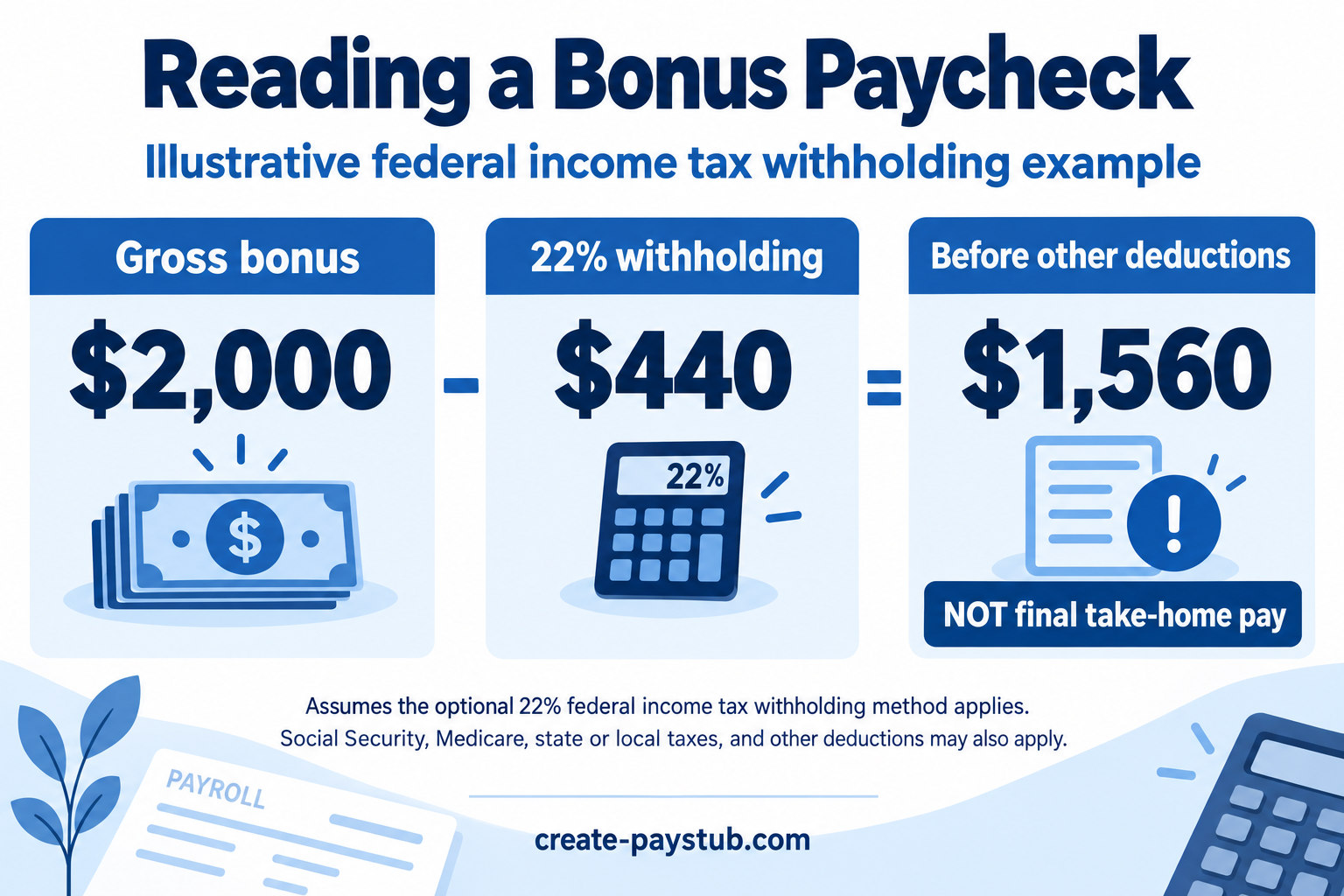
Assume a fictional payment qualifies for the optional 22% method: $2,000 × 22% = $440 of federal income tax withholding. The remaining $1,560 is an intermediate subtotal, before other applicable taxes or deductions.
Social Security and Medicare, plus applicable state or local taxes and other deductions, can reduce the payment further. Read the actual lines; our FIT versus FICA guide helps distinguish federal income tax from payroll taxes.
Does withholding tell me my final bonus tax?
No. Withholding is a payment toward income tax, not a separate final assessment for that bonus. The IRS explains in its tax withholding guidance that too little withholding can leave a balance due and too much can lead to a refund. Your overall tax situation determines the result; a bonus deduction does not guarantee either outcome.
If the bonus materially changes your expected annual income, consider reviewing your overall withholding using the IRS resources linked above. Have recent statements and relevant household income information ready. A qualified tax professional can help with circumstances that a simple paycheck comparison cannot resolve.
What should you ask payroll to check?
- The award amount: Does the gross bonus match the written terms, including any stated adjustment?
- The payment: Was the bonus included with regular wages, or issued as a separate payment?
- The withholding method: Which federal method was used, and which wages entered the calculation?
- Other deductions: Which entries apply to this payment, and what authorizes them?
- The deposit: Does net pay match the total paid across your designated accounts? See our guide to a deposit that differs from net pay.
You can write: “My bonus notice shows [amount], and the statement dated [date] shows [gross bonus]. Please explain the federal withholding method and the other deductions applied to this payment.” Include the relevant statement through your employer's secure channel.
Keep the award notice, original statement, and any correction together. This guide explains how to review a paycheck; it does not calculate your individual tax liability.