
If you work two jobs at different hourly rates for the same employer, the overtime rate on your pay stub may not equal one-and-a-half times either listed rate. A weighted-average calculation can produce a separate regular rate for the workweek. Start with the hours and earnings for each job rather than choosing the higher or lower rate by guesswork.
Why the regular rate can be different from both job rates
The Department of Labor's Fact Sheet 23 describes a weighted average when different straight-time rates apply to different work in a single workweek: combine the earnings at those rates and divide by the total hours worked. The hours at each rate matter; simply averaging the two hourly rates can give the wrong result.
Use one workweek for this review. If your statement covers two weeks, our biweekly overtime guide explains how to separate the weekly calculations before comparing the combined paycheck.
Fictional example: 30 hours at $20 and 15 hours at $26
Assume a covered, nonexempt hourly employee works both jobs for one employer in one workweek. The standard federal overtime-after-40-hours rule and weighted-average method apply. There are no bonuses, other earnings adjustments, special overtime arrangements, or additional state requirements in this example.
- Job A: 30 hours × $20 = $600 in straight-time earnings.
- Job B: 15 hours × $26 = $390 in straight-time earnings.
- Combined hours: 30 + 15 = 45 hours worked.
- Combined straight-time earnings: $600 + $390 = $990.
- Weighted regular rate: $990 ÷ 45 = $22 per hour.
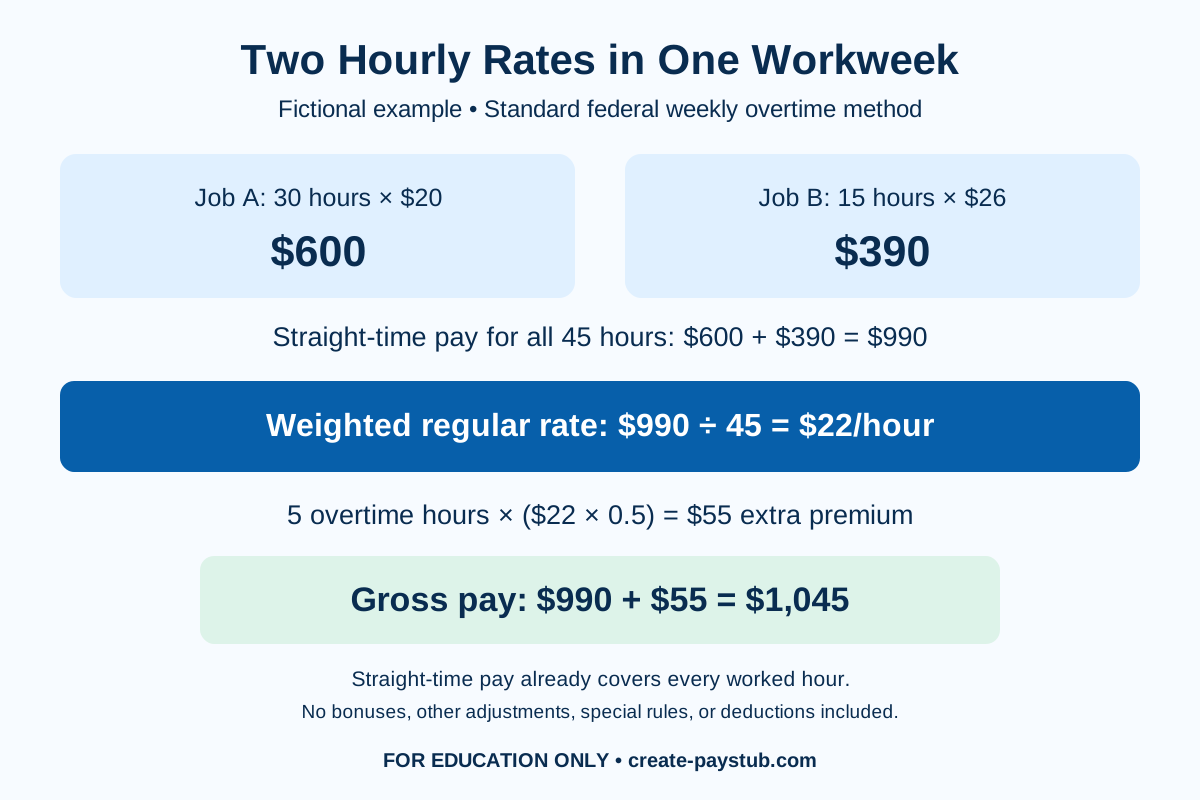
A simple average of $20 and $26 would be $23. That treats the two rates as if they had equal hours, which they do not here. Dividing total earnings by actual hours gives $22 instead.
Why an additional half-time premium can be correct
In this example, five of the 45 worked hours exceed 40. Because the $990 already includes straight-time pay for every hour, the remaining premium is half the $22 regular rate for those five hours:
- Additional premium per overtime hour: $22 × 0.5 = $11.
- Additional overtime premium: 5 × $11 = $55.
- Total gross earnings: $990 + $55 = $1,045 before deductions.
The DOL's overtime presentation explains the additional half-time approach when straight-time earnings at the different rates have already been paid. A line labeled “OT premium” therefore needs to be read alongside the other earnings lines.
Adding five hours at the full $33 rate on top of the $990 would count the straight-time component again. Conversely, seeing a small premium line does not prove correctness: first verify that all straight-time earnings are actually included. Payroll layouts vary, so compare the full calculation rather than requiring an identical label or row format.
When this example is not enough
Fact Sheet 23 also describes a conditional alternative under section 7(g)(2), using the rate in effect during overtime work. Do not assume that a different method is automatically wrong or automatically permitted; ask which method and requirements apply.
Other compensation can change the calculation. The DOL's regular-rate overview explains that some payments are included and others may be excluded under the law. Our shift differential guide helps distinguish a separate premium from a combined hourly rate so you do not count the same earnings twice.
This example also does not decide whether daily overtime, a special industry arrangement, or another applicable rule changes your result. It is a worked illustration for the stated assumptions, not a universal payroll formula.
What to ask payroll when the amounts do not match
- Confirm the employer's workweek boundaries and the hours assigned to each job.
- Compare each job's rate with your pay agreement and its effective date.
- Request the earnings and hours used to calculate the regular rate.
- Identify where straight-time pay for overtime hours appears.
- Ask how any other compensation or applicable overtime rules affected the premium.
“For the workweek ending [date], my records show [hours] at [rate] and [hours] at [rate]. Please show the regular-rate calculation, the overtime hours, and where the straight-time and additional premium amounts appear on my statement.”
Keep the time records, statement, and explanation together. If payroll confirms an error, use our pay stub correction checklist to track the corrected statement and payment.