
A shift differential is extra compensation for qualifying work, such as an evening or night shift. On a pay stub it may appear separately from base earnings. Check the agreed premium, the hours that qualify, and whether the extra amount is already included in another earnings line before adding anything to gross pay.
Start with the employer's differential policy
Find the policy, offer terms, or agreement that describes the premium. Does it apply to the entire shift or only hours within a specified time window? Is it a flat hourly amount or a percentage? Does the policy address shifts that cross midnight, paid leave, or overlapping premiums? Ask about those details before choosing the hours for your calculation.
The Department of Labor's night work and shift work guidance explains that the FLSA does not itself require extra pay simply for night work; a night-shift premium is a matter of agreement. Applicable state rules or contractual requirements may also matter. Do not assume every workplace offers the same differential.
Example: 40 hours at $20, with 16 hours eligible for $2 extra
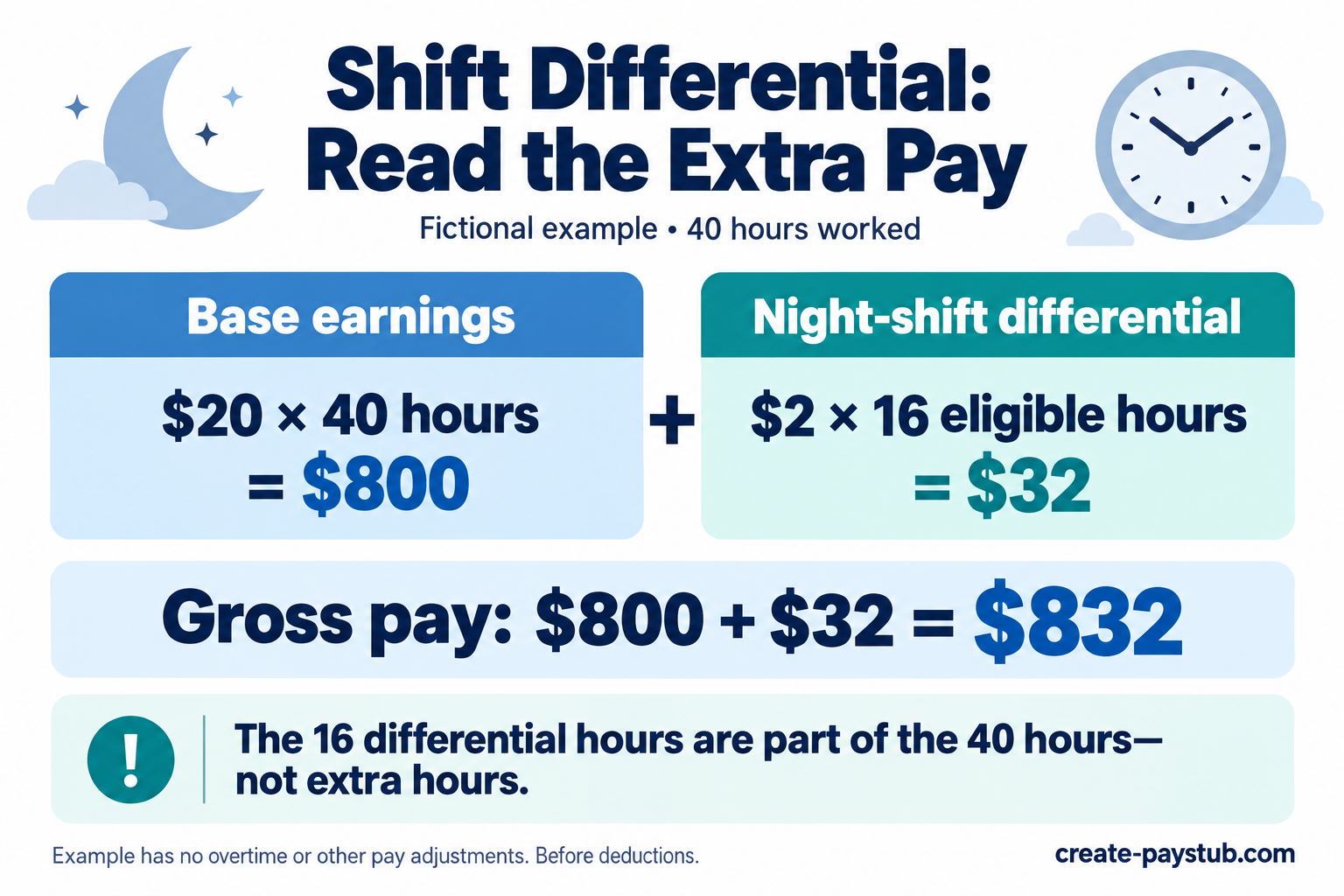
Assume a fictional employee works 40 hours in one workweek at a base rate of $20 per hour. Of those 40 hours, 16 qualify for an additional $2 per hour under the employer's policy. Assume no overtime, bonuses, or other earnings adjustments.
- Base earnings: 40 × $20 = $800.
- Shift differential: 16 × $2 = $32.
- Total gross pay: $800 + $32 = $832, before deductions.
The same arithmetic can be displayed another way: 24 hours at $20 equals $480, and 16 hours at the combined $22 rate equals $352. Together they equal $832. If your statement already uses the combined rate for those 16 hours, adding another $32 would count the premium twice.
Why the hours columns can look misleading
In the separate-line version, you may see 40 base hours and 16 differential hours. That does not mean the employee worked 56 hours. The second line uses a subset of the first line's hours to calculate an additional earning amount. Match the labels and time records before totaling the hours displayed across every row.
Ask payroll whether a differential row is an additional payment, a breakdown of an amount already included, or an informational entry. A repeated hour quantity is not enough to decide that on its own. Our check stub reading guide provides a broader review of earnings and deductions.
If qualifying time includes part of an hour, convert minutes correctly before multiplying. For example, 7 hours 30 minutes is 7.50 hours, not 7.30. See how to read decimal hours for the conversion method.
Does a shift differential affect overtime?
It can affect the regular rate used for overtime. The Department of Labor's Fact Sheet 54 discusses including shift differentials in the regular rate and provides examples. Its health-care context also includes special arrangements, so identify which overtime method actually applies to your job.
The no-overtime example above does not calculate a regular rate for an overtime week. When a workweek includes overtime, request the earnings included in the regular rate, the hours used, and the premium calculation. Do not assume the overtime line should always be one-and-a-half times only the base rate, or add a full overtime payment again when straight-time pay for those hours is already included.
Our biweekly overtime guide helps separate workweeks and distinguish full overtime earnings from an additional overtime premium. Multiple rates and other compensation may require a more detailed calculation than the example on this page.
A practical differential-pay checklist
- Confirm the rule: record the premium amount or percentage and eligibility window.
- Match the time: compare approved time entries with the hours the policy covers.
- Identify the layout: establish whether the premium is separate or already included in a combined rate.
- Check gross earnings: reconcile earnings lines before comparing take-home pay or deposits.
- Review overtime if applicable: ask for the workweek calculation and regular-rate inputs.
- Keep the records: save the statement, relevant policy, timecard, and payroll explanation together.
A focused request is: “For pay date [date], my records show [hours] that appear eligible for the [amount or percentage] shift differential. Please confirm which hours qualified, where the differential is included in gross pay, and how it affected any overtime calculation.”
If the amount remains unexplained, follow our pay stub correction checklist. Keep the original statement and request a documented correction rather than changing the employer-issued record yourself.