
A biweekly paycheck can include overtime even when its total hours are 80 or fewer. Under the standard federal weekly overtime rule, the key is how many hours you worked in each workweek, not the average across the two-week pay period. To check your statement, use your time records alongside the earnings lines on your pay stub.
1. Find the workweek used by your employer
For covered, nonexempt employees under the standard FLSA rule, overtime is generally due after 40 hours worked in a workweek at no less than 1.5 times the regular rate. A workweek is a recurring seven-day period; it need not start on Monday. The Department of Labor says employers cannot average hours over multiple weeks to apply this rule. See DOL Fact Sheet 23.
Ask payroll for the day and time your workweek starts if it is not clear from your records. Then sort your worked hours by that boundary. A pay period, a workweek, and a pay date serve different purposes; our pay period versus pay date guide explains the payment labels.
2. Check each week before adding the hours
Fictional example: Assume a covered, nonexempt hourly employee works 45 hours in the first workweek and 35 in the second. The standard federal weekly rule applies, with no special exception or additional state overtime requirement in this example.
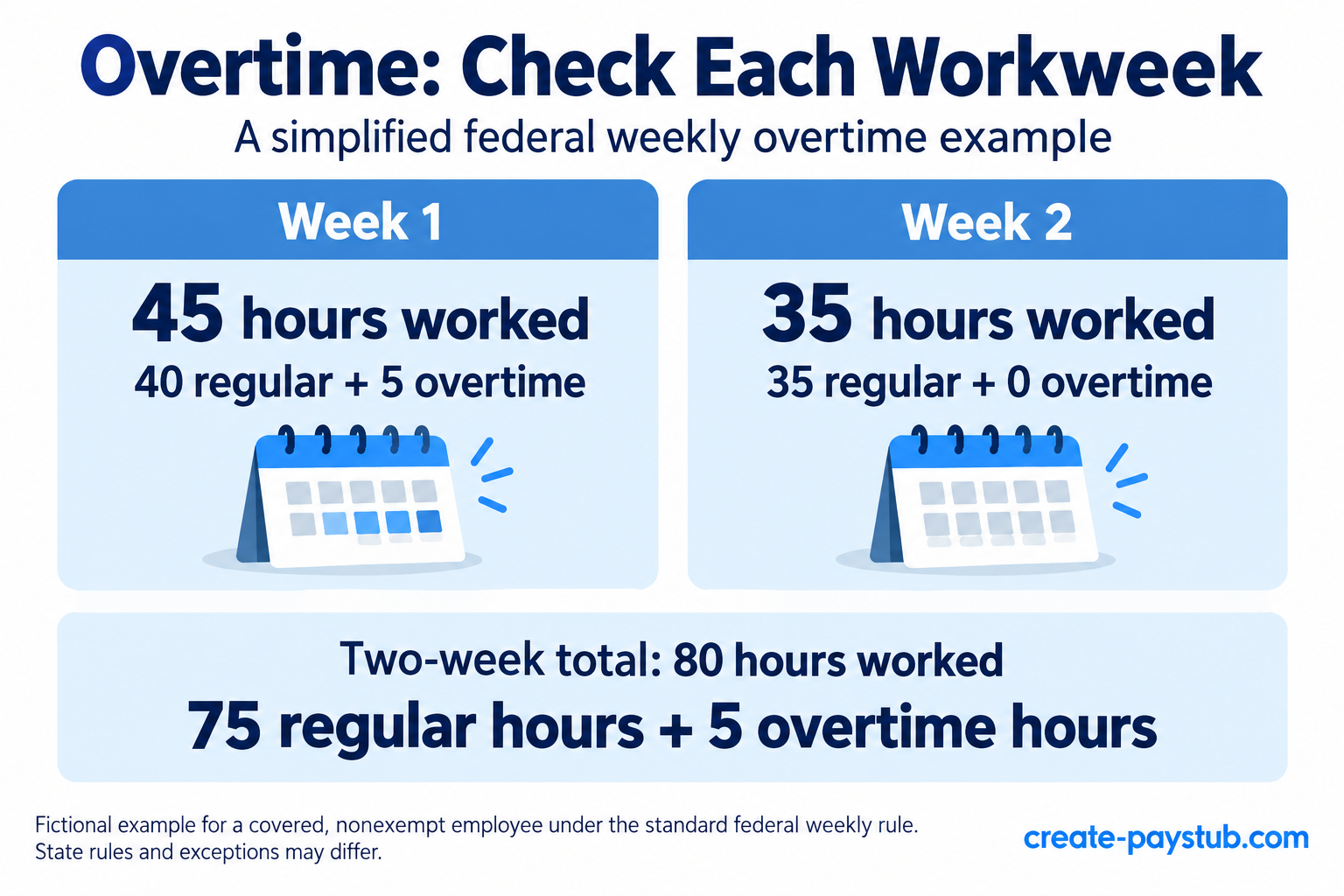
- Week one: 40 regular hours and 5 overtime hours.
- Week two: 35 regular hours and no overtime hours.
- Combined: 75 regular hours and 5 overtime hours, for 80 hours worked.
For this employee, treating the total as 80 regular hours would miss the first week’s overtime. Keep the two weekly calculations visible when you compare them with the statement.
3. Compare the dollar amounts, not just the line labels
Extend the fictional example by assuming a single $20 hourly rate, which is also the regular rate for overtime, with no bonuses or other adjustments. The full overtime rate is $30 per hour.
- 75 regular hours × $20 = $1,500.
- 5 overtime hours × $30 = $150.
- Total gross earnings = $1,650 before deductions.
A different presentation could show straight-time pay for all 80 worked hours ($1,600), then an additional half-time premium for the 5 overtime hours ($50). That also totals $1,650. These are two ways to describe the same arithmetic in this example, not a requirement that your payroll software use either layout.
If a line labeled “OT premium” looks smaller than expected, first ask whether the straight-time portion is already included elsewhere. Conversely, do not count a full overtime payment twice. For help separating earnings from deductions and deposits, see how to read a check stub.
4. Check whether the simple example fits your situation
Your regular rate may differ from your basic hourly rate. Certain bonuses and other compensation can affect it. The Department of Labor’s regular-rate guidance explains what is included or excluded. If you have multiple pay rates, incentive pay, or a complex pay arrangement, ask for the actual regular-rate calculation rather than applying $20 × 1.5 from this example.
State law can also change the result. For example, California’s general rules include daily overtime, subject to exemptions and exceptions. Its official overtime FAQ describes those rules. A weekly-only check is not sufficient for every worker or location.
This guide is an arithmetic check for a standard hourly arrangement, not a determination that you are covered or nonexempt. If your employer uses a special overtime arrangement, request an explanation of the applicable rules.
5. Ask payroll a specific question if the totals do not reconcile
Gather the statement, your daily time records, and the workweek boundaries. A useful message is: “For the pay period ending [date], my records show [hours] in the first workweek and [hours] in the second. Can you show how the regular hours, overtime hours, regular rate, and overtime premium were calculated?”
Keep the original documents and any written explanation. If a difference remains unresolved, contact the appropriate labor agency or a qualified adviser. If you need older statements, our guide to getting pay stubs from a former employer includes a request template.
If you prepare pay statements, establish the correct hours and earnings from your payroll records before entering them into a pay stub maker. Formatting a statement does not establish the overtime calculation or correct missing wages.