
An unpaid lunch can explain why the paid hours on your pay stub are lower than the time between clock-in and clock-out. Check the timecard first: a meal may be removed from the hours used to calculate gross pay, rather than appearing as a dollar deduction below gross pay. The key question is whether the recorded break matches what actually happened.
Example: 8.5 hours at work, 8.0 paid hours
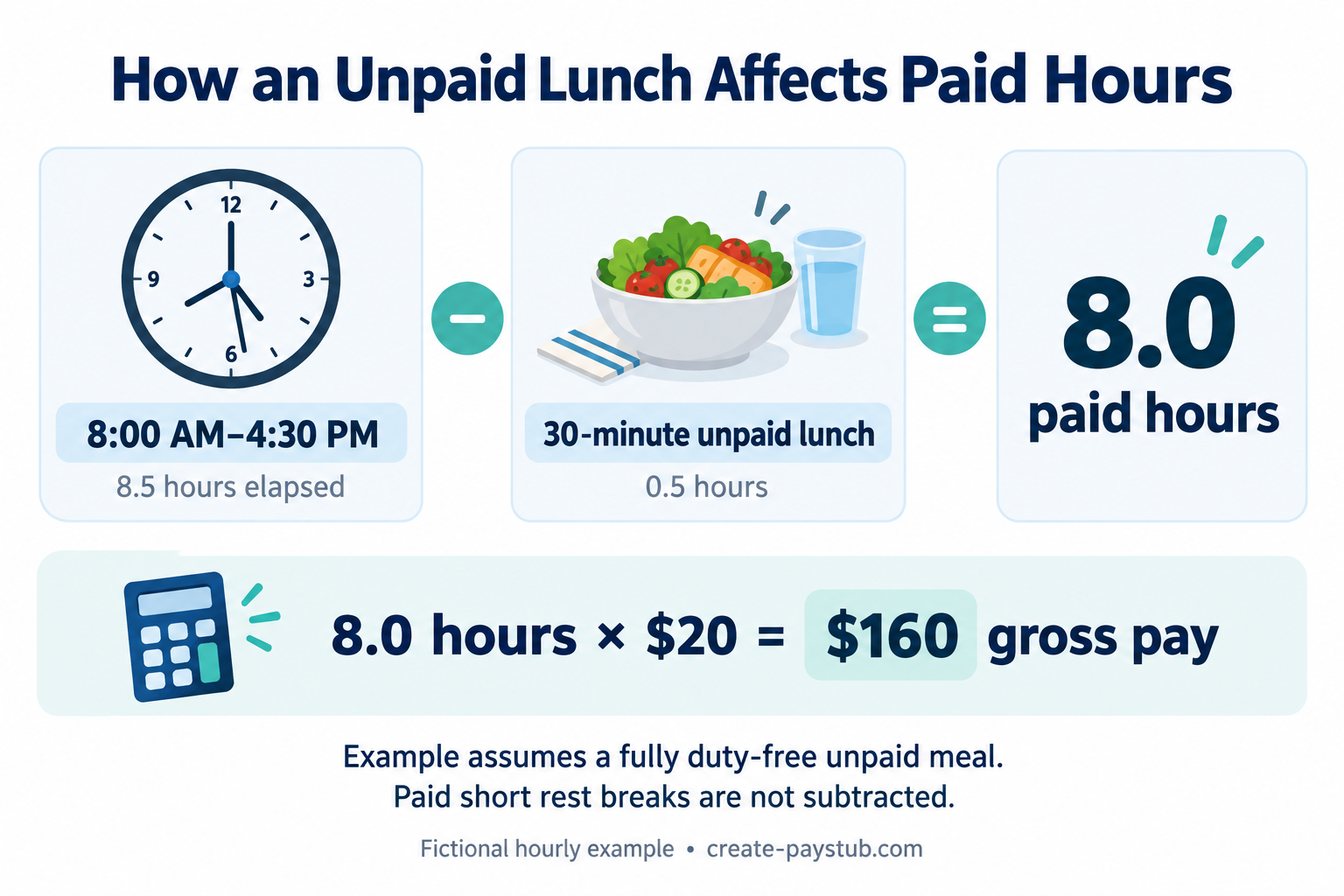
Consider a fictional hourly employee who starts at 8:00 a.m. and finishes at 4:30 p.m. Assume the employee takes a fully duty-free, unpaid 30-minute meal, all remaining time is paid, and the applicable straight-time rate is $20 per hour:
- Elapsed time: 8 hours 30 minutes, or 8.5 hours.
- Unpaid meal: 30 minutes, or 0.5 hour.
- Paid time: 8.5 − 0.5 = 8.0 hours.
- Gross earnings for this day: 8.0 × $20 = $160, before taxes and other deductions.
If each of five days follows that same pattern, the timecard shows 42.5 elapsed hours, 2.5 unpaid meal hours, and 40 paid hours. This arithmetic is an illustration, not a rule that every lunch is unpaid or that every employee follows this schedule.
Remember that 30 minutes is 0.50 hour, not 0.30 hour. Our decimal-hours guide explains how to convert other minute amounts before checking earnings.
An unpaid meal is different from a short rest break
The U.S. Department of Labor explains that employer-provided short breaks, generally 5 to 20 minutes, count as compensable work time under the FLSA. Do not subtract ordinary paid coffee or rest breaks when checking paid hours. See the Department's breaks and meal periods guidance.
For meals, duration alone does not settle the question. The Department's meal-period advisor explains that an employee must be completely relieved of duties. Being required to answer calls or monitor equipment while eating can mean the time is work time. Merely remaining on the premises does not by itself make a duty-free meal paid.
State requirements, applicable agreements, and employer policies may provide additional protections or paid meals. Check the rules for where you work through the relevant state labor office. This guide addresses an hourly record-checking example; it does not determine whether a particular employer's practice is lawful.
How to compare your timecard with your pay stub
- Match the dates. Use the timecard for the pay period covered by the statement, not simply the week containing payday.
- Review each shift. Record start time, finish time, and the meal time actually taken. Check whether the system already removed lunch before subtracting anything yourself.
- Separate the pay categories. Regular work, overtime, and paid leave may appear on different lines. Compare matching categories rather than assuming one hours field includes everything.
- Check the rate and earnings. Apply the relevant rate to each category. The simple $20 calculation above does not cover differentials, multiple rates, or overtime premiums.
- Keep the originals. Save the statement and time record before requesting a correction, so you can compare the revised figures.
A meal adjustment may also change the hours used in an overtime calculation. For the separate weekly review, see how to check overtime on a biweekly pay stub; do not rely only on the two-week total.
What if lunch was deducted but you worked through it?
Report the specific shift and what happened. An automatic 30-minute entry does not tell you whether you actually received that break. Collect the original punches, the meal entry, any recorded correction, and a brief description of duties performed during the period.
A practical message to payroll is: “On [date], my timecard shows a [length] meal deduction. I [worked through the meal / performed these duties during it]. Please review the recorded time, explain the paid-hours calculation, and confirm whether my statement needs a correction.”
Use our pay stub correction checklist to follow up and compare the replacement record. If the issue remains unresolved, the Department of Labor's Wage and Hour Division offices or your state labor office can help identify the relevant rules.
Will unpaid lunch appear under deductions?
It may be reflected in paid hours before gross earnings are calculated instead. Start with the timecard and hours lines. Do not assume a smaller gross amount is caused by tax withholding, and do not subtract the same meal again from a paid-hours total that already excludes it.