
If your pay stub shows 7.50 hours, that means seven hours and thirty minutes when the field uses decimal hours. The digits after the decimal point are a fraction of an hour, not a count of minutes. Confirm the format before deciding that your time record and paycheck disagree.
How do you convert hours and minutes?
Divide the minutes by 60, then add the whole hours. For seven hours and thirty minutes, the calculation is 7 + (30 ÷ 60) = 7.50 hours. This changes the notation, not the amount of time.
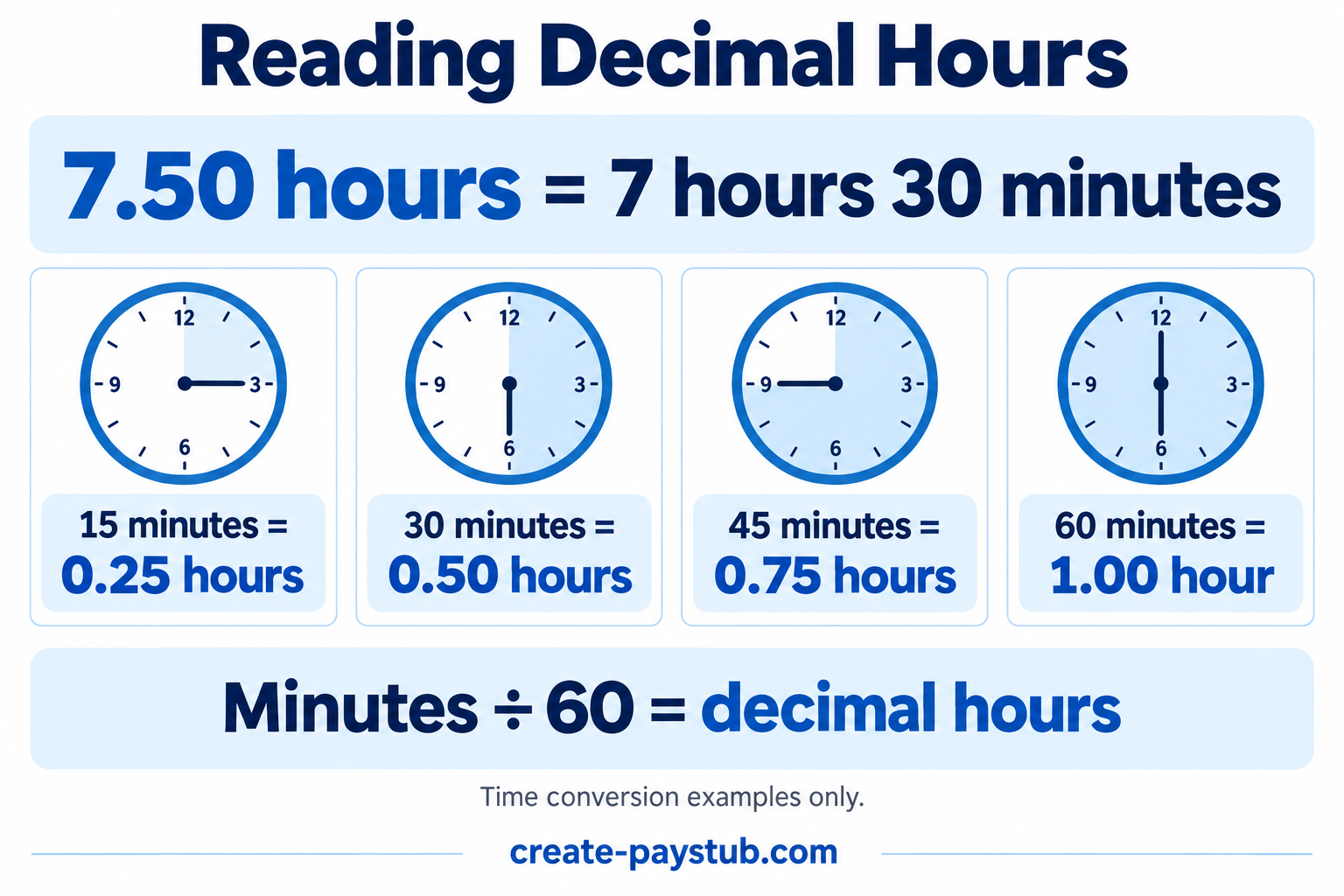
- 7 hours 15 minutes = 7.25 hours.
- 7 hours 30 minutes = 7.50 hours.
- 7 hours 45 minutes = 7.75 hours.
- 8 hours exactly = 8.00 hours.
The Department of Labor describes a payroll system converting seven hours and thirty minutes to 7.500000 hours in its 2019 timekeeping opinion letter. That letter addresses the specific system presented; it is not a blanket approval of every rounding practice.
What does 7.30 hours mean?
In decimal format, 7.30 hours means seven hours and eighteen minutes: 0.30 × 60 = 18 minutes. In contrast, a duration written as 7:30 in an hours-and-minutes field means seven hours and thirty minutes.
To convert back, keep the whole hours and multiply only the fractional part by 60. For example, 8.25 hours becomes eight hours plus 0.25 × 60, or fifteen minutes. Ask payroll about the field definition if the statement does not identify its format.
How can the format affect an earnings check?
Assume a fictional straight-time earnings line for 7 hours 30 minutes at $20 per hour, with no other earnings involved. The calculation is 7.50 × $20 = $150 gross.
Entering 7.30 instead would produce $146, a $4 difference. That example illustrates a conversion mistake; it does not establish a shortage in a real paycheck. Check the underlying hours and rate before treating the difference as an error.
Gross earnings are not the deposit amount. Taxes and other deductions come later; see our guide to reading a check stub for the distinction between gross and net pay.
Why might the displayed total differ slightly?
Some minute values cannot be represented exactly with two decimal places. Ten minutes is one-sixth of an hour, or 0.1666… hours. Written to two decimal places, it is approximately 0.17 hours.
Three ten-minute intervals total thirty minutes, or exactly 0.50 hours. Adding three already-rounded values of 0.17 produces 0.51 instead. For your own comparison, retain the original minutes and convert the total, or retain enough decimal precision until the final step.
A displayed value may have less precision than the value used in a calculation. Ask whether payroll calculates from original minutes, more precise decimal values, or rounded entries. Do not assume that a display difference proves either an underpayment or an acceptable practice. Rules about rounding work time are a separate issue from converting units.
What should you check before contacting payroll?
- Match the pay period on the statement to the time record.
- Confirm whether each field uses decimal hours or hours and minutes.
- Separate worked time from leave and other paid-hour categories.
- Keep the original time entries and show your conversion calculation.
- Ask how displayed precision and any rounding affect the paid amount.
The Department of Labor's recordkeeping fact sheet explains that covered employers must maintain specified records for nonexempt workers, including daily and weekly hours. Those underlying records matter when reconciling a summary statement.
You can ask: “My time record shows [hours and minutes], while the statement shows [decimal figure]. Which format and precision are used, and can you show how this earnings line was calculated?” If the discrepancy remains, use our pay stub correction checklist to organize the request.