
Additional Medicare Tax on a pay stub is an extra employee tax of 0.9% on Medicare-covered wages an employer pays above $200,000 in a calendar year. It is added to regular Medicare withholding of 1.45%, so a Medicare deduction can rise even when the pay amount stays the same. The important check is how much of the current payment falls above the employer's threshold—not whether the entire paycheck should suddenly be multiplied by 2.35%. These are the federal rules for ordinary covered employee wages in 2026, described in IRS Publication 15.
There are two separate questions: Did payroll withhold the right amount from this employer's payment? and Will the withholding cover the tax on your return? A correct paycheck calculation does not guarantee that the second answer is yes. This guide separates those checks and gives a fictional example you can follow with your own payroll records.
Why a new Medicare deduction can appear mid-year
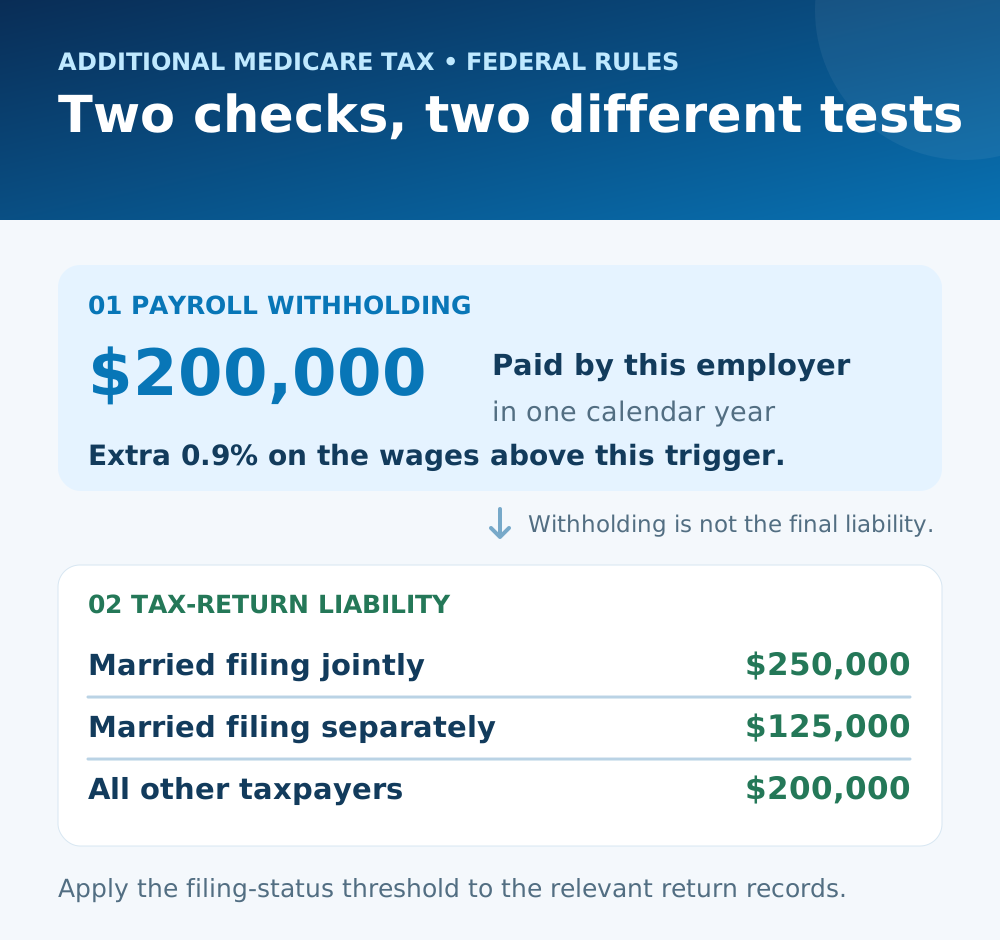
The employer must start the extra withholding in the pay period when its calendar-year payments to you exceed $200,000. It then continues on wages above that threshold through the end of the year. The $200,000 withholding trigger does not change because you are married, have another job, or expect to owe no Additional Medicare Tax on your return. The IRS withholding-rate guidance also explains that there is no employer match for the extra 0.9%. The employer's regular Medicare contribution is separate from the employee amount deducted from pay.
Your payroll system may show the extra amount separately or combine it with the regular Medicare deduction. A label such as “Addl Medicare” is a clue, but ask payroll how its labels work before adding two lines together. You could otherwise count a separate detail line a second time when it is already included in a displayed total. Our FIT versus FICA guide explains how to keep Medicare, Social Security, and federal income-tax deductions separate.
Find Medicare wages before checking the percentage
Use the wages subject to Medicare tax. Gross earnings, federal income-tax wages, Social Security wages, and net pay can be different amounts. For example, the IRS guidance on 401(k) plans explains that traditional pre-tax employee deferrals generally remain subject to Social Security and Medicare tax even though they reduce federal income-tax wages. Subtracting every benefit deduction from gross pay is not a reliable way to reconstruct Medicare wages.
Request these three figures for the same employer and calendar year: Medicare wages before the payment, Medicare wages included in the payment, and the current employee Medicare tax. Use the previous statement's YTD wages as the opening balance. The current statement's YTD amount generally already includes the current payment; using it as the starting balance and adding the paycheck again would count those wages twice. Our YTD reconciliation guide explains this timing.
Regular Medicare tax has no annual wage-base cap. Reaching the Social Security cap does not turn Medicare off. If Social Security has stopped but Medicare remains or increases, review each tax separately; see why Social Security withholding can stop during 2026. Special coverage, payroll corrections, taxable benefits, and tips can require a different reconciliation from the simple wage example below.
Worked example: the paycheck that crosses $200,000
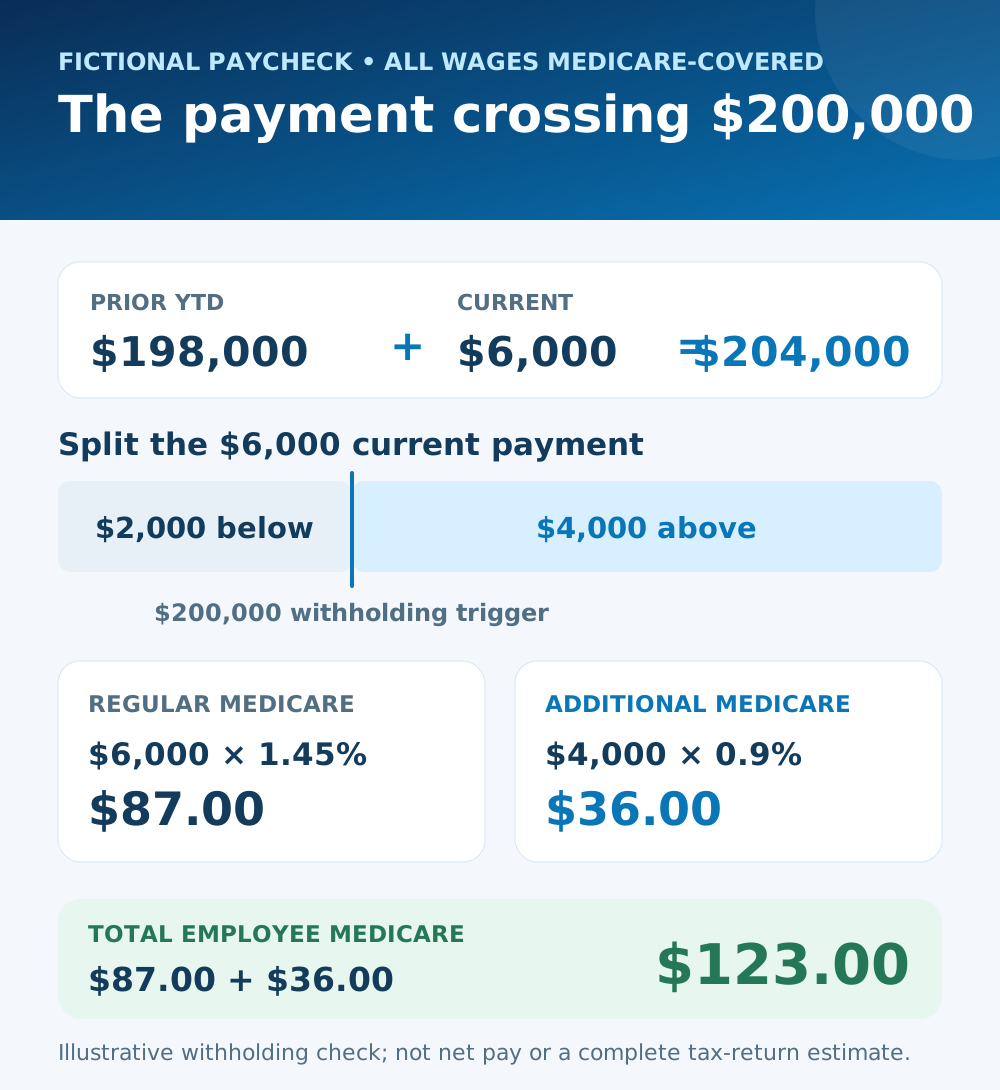
Assume a fictional employee has $198,000 in Medicare wages from one employer before a payment of $6,000. All $6,000 is Medicare-covered wages. There are no reversals, uncollected taxes, employer-paid employee taxes, or special payroll arrangements.
- New YTD wages: $198,000 + $6,000 = $204,000.
- Current wages above the trigger: $204,000 − $200,000 = $4,000. Only that $4,000 portion crosses above the threshold on this payment.
- Regular employee Medicare: $6,000 × 1.45% = $87.00.
- Additional Medicare withholding: $4,000 × 0.9% = $36.00.
- Total employee Medicare on this payment: $87.00 + $36.00 = $123.00.
Multiplying the entire $6,000 by 2.35% would produce $141.00, which is $18.00 too high for this crossover check under these assumptions. The first $2,000 of the payment is below the trigger. If the next payment is another $6,000 of covered wages from the same employer, all of that later payment is above the threshold: $87.00 regular Medicare plus $54.00 additional withholding equals $141.00. The 2026 employer guide supports applying the extra withholding only to wages above the trigger.
For a later check that starts with wages already above $200,000, the additional portion is normally all of the current covered wages. For a check that remains entirely below the trigger, it is zero. If the stub does not provide the wage base or shows an adjustment, ask payroll for its calculation rather than trying to infer the rule solely by dividing the tax by gross pay.
Why your filing status does not change payroll's trigger
IRS Topic 560 gives these thresholds for determining Additional Medicare Tax liability:
- Married filing jointly: $250,000.
- Married filing separately: $125,000.
- All other taxpayers: $200,000, including single, head of household, and qualifying surviving spouse.
The employer still uses its $200,000 withholding trigger. It does not combine your pay with your spouse's wages or ordinary wages from another employer. That difference can create additional tax even when no employer withheld it, or withholding that is credited against your return when your final Additional Medicare Tax liability is lower. Neither outcome alone proves a payroll error.
These simplified examples assume ordinary Medicare wages only, no self-employment income, and no special employment arrangements:
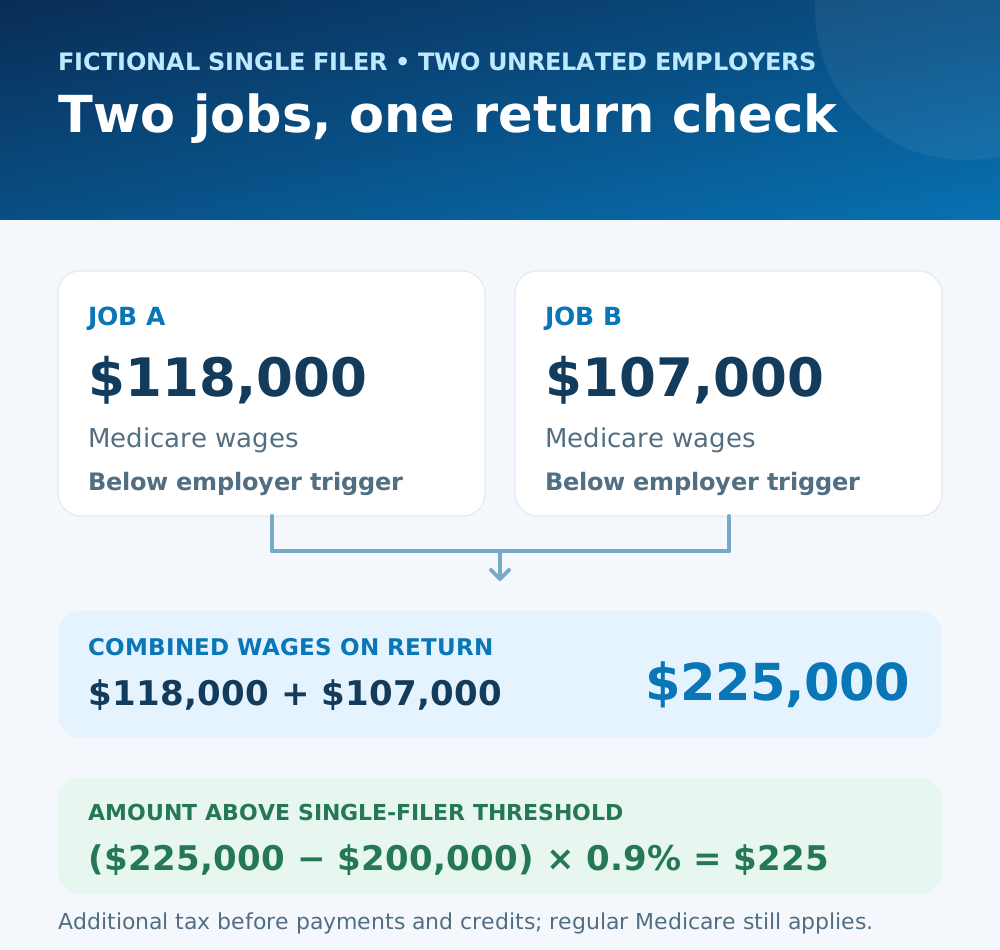
- Two jobs, single filer: $118,000 from one unrelated employer plus $107,000 from another is $225,000. Neither employer individually crosses $200,000. The wage-based additional tax on the return is ($225,000 − $200,000) × 0.9% = $225, before considering payments and credits.
- Joint return, withholding exceeds this tax's liability: one spouse receives $214,000 from an employer and the other earns $16,000. The first employer withholds ($214,000 − $200,000) × 0.9% = $126. Combined wages of $230,000 are below the $250,000 joint threshold. The withheld amount is credited on the return; it is not automatically a separate $126 cash refund, because the overall return may contain other taxes.
What to do when withholding will not cover the tax
The IRS Additional Medicare Tax FAQs explain that you cannot request voluntary withholding specifically for this tax. You can request additional federal income-tax withholding on Form W-4, and estimated payments may also be appropriate. Those payments are applied against your overall tax liability. A W-4 change does not replace the employer's mandatory $200,000 trigger, and an employer cannot stop required withholding just because you expect to file jointly.
Form 8959 is used to calculate Additional Medicare Tax and reconcile amounts withheld. Use the form and instructions for the tax year you are filing, with all required wage and income records. This article's payroll math does not estimate your entire tax return.
If you also have self-employment income, do not apply the paycheck example to business revenue. Topic 560 describes calculating the wage portion first and then reducing the applicable threshold for the self-employment calculation. Railroad retirement compensation has separate rules; corporate acquisitions and other special payroll arrangements can also affect which wages an employer counts. Ask for the relevant calculation rather than assuming every employer change starts from zero.
Reconcile the final pay stub with W-2 boxes 5 and 6
The 2026 W-2 instructions define box 5 as Medicare wages and tips, with no wage-base limit, and box 6 as total employee Medicare tax withheld, including Additional Medicare Tax. The employer's own share is not included in box 6. If your final stub separates regular and additional Medicare, ask whether the W-2 total combines those YTD employee amounts.
If the fictional crossover payment above were the last payment of the year, box 5 would be $204,000 under the stated assumptions. Regular employee Medicare would be $204,000 × 1.45% = $2,958; additional withholding would be $36, producing $2,994 total in box 6. This is a reporting check for that example, not a universal formula when tips, corrections, uncollected taxes, or other adjustments are involved.
Do not compare Medicare tax with W-2 box 2, which reports federal income-tax withholding, or assume box 1 must equal box 5. Our W-2 versus pay-stub guide explains why annual wage categories can differ.
A focused checklist when the deduction looks wrong
- Identify the tax: confirm which employee lines contain regular Medicare and Additional Medicare Tax, and whether either is included in a combined total.
- Match the year and employer: distinguish the payroll withholding check from the later calculation using all relevant tax-return records.
- Request the wage base: obtain prior YTD Medicare wages and the current payment's covered wages, rather than using net pay or a different taxable-wage category.
- Check the crossover portion: determine how much of this payment falls above $200,000; only that portion receives the additional 0.9% on the crossing check.
- Ask about adjustments: confirm whether a bonus, taxable benefit, correction, or special payroll arrangement explains a difference.
- Keep withholding and liability separate: use the applicable filing-year instructions to reconcile multiple jobs, a spouse's earnings, and any other relevant income.
A useful payroll question is: “For my payment dated [date], please confirm the Medicare wages before this payment, this payment's Medicare wages, and the regular and additional employee Medicare amounts. Is the additional amount already included in the displayed Medicare total?” Keep the original statement and request an employer correction if a genuine error remains. Our pay-stub correction checklist helps document the issue. Formatting another pay stub does not correct the employer's payroll or W-2.