
A pay period is the span of time covered by a payment. A pay date is the date that payment is scheduled to be made. Your check stub can show both, and the two dates do not have to match.
Understanding the difference helps you compare a stub with your timesheet, identify which payment you are looking at, and enter the right dates when preparing pay records.
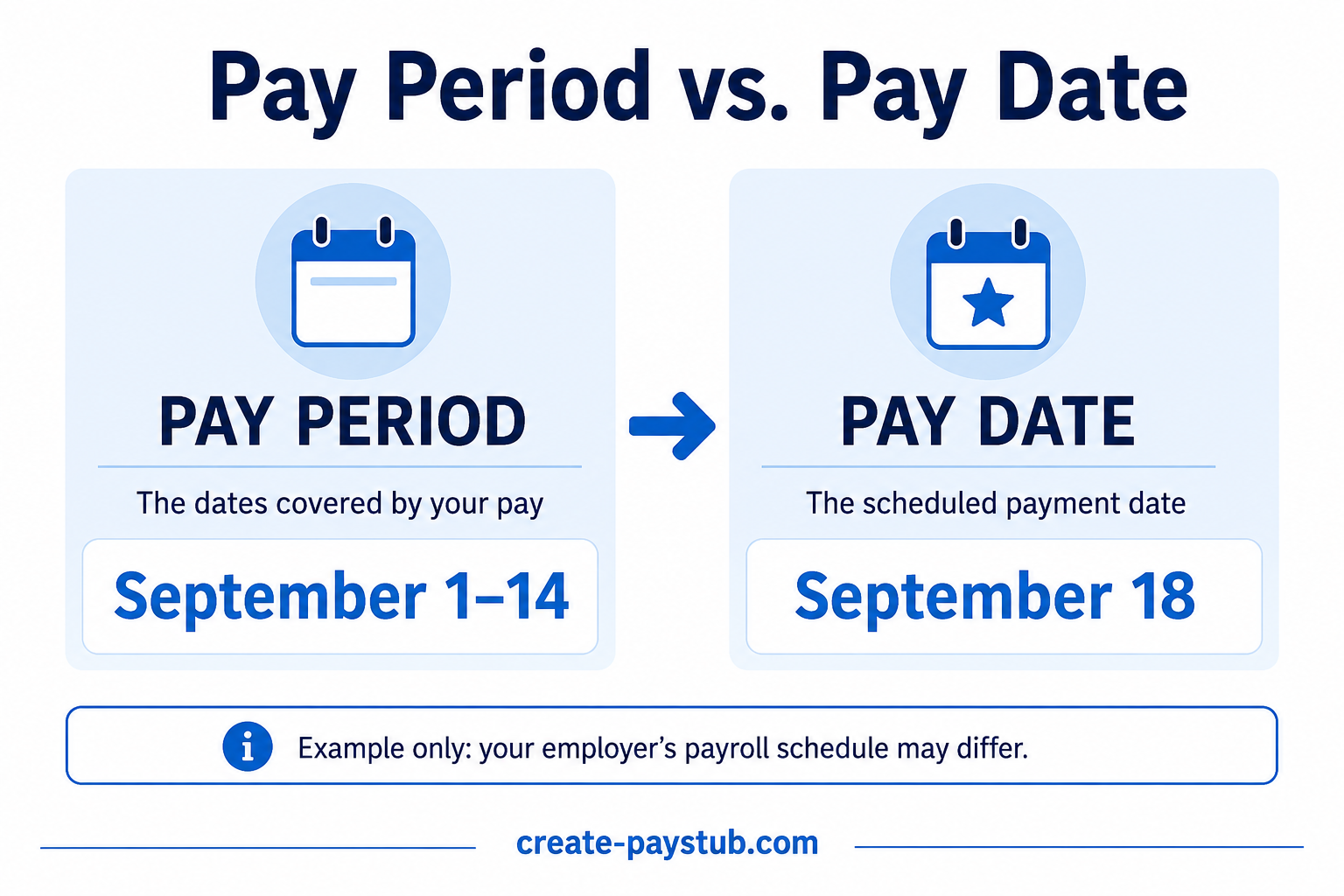
The difference at a glance
- Pay period
- The start and end dates for the period covered. Use these dates to match the statement to the appropriate work records.
- Pay date
- The date assigned to the payment. Use it to identify that payroll payment and compare it with the payment information provided by your employer.
The Consumer Financial Protection Bureau’s pay stub guide describes the pay period as the calendar days included in the paycheck. A statement may label the separate payment date “pay date,” “payment date,” or “check date.” If a label is ambiguous, ask payroll how it is used.
A simple date example
Imagine a statement with these details:
- Pay period start: September 1.
- Pay period end: September 14.
- Pay date: September 18.
The statement covers September 1–14, even though the scheduled payment comes later. When checking regular hours, begin with the records for that period. Do not compare the stub with hours worked through September 18 simply because that is the pay date.
This example is only an illustration. Use your employer’s actual schedule rather than assuming every business leaves the same gap between the period end and payday.
Common pay schedules
Pay frequency describes how often the regular payroll repeats. These are four common arrangements:
- Weekly: once each week, typically 52 regular paydays per year.
- Biweekly: every two weeks, typically 26 regular paydays per year.
- Semimonthly: twice each month, normally 24 regular paydays per year.
- Monthly: once each month, normally 12 regular paydays per year.
The Bureau of Labor Statistics explains these usual payday counts. Treat them as a starting point: check the actual payroll calendar for the year, especially with weekly or biweekly schedules, where calendar alignment can affect the count.
Biweekly is different from twice monthly
“Every two weeks” follows a repeating 14-day cycle. “Twice a month” follows two scheduled payments in each month. The phrases sound similar, but they do not describe identical calendars.
Consider a simplified annual salary of $62,400, paid in equal installments with no adjustments:
- Across 26 installments: $62,400 ÷ 26 = $2,400 gross per payment.
- Across 24 installments: $62,400 ÷ 24 = $2,600 gross per payment.
The larger installment in the second example does not mean the annual salary is higher. There are fewer installments. These are gross-pay arithmetic examples, not take-home estimates or instructions for calculating a partial paycheck.
Before comparing two job offers or two stubs, check both the amount and the frequency. Comparing one check with another can be misleading when they cover different schedules.
What to check on your stub
- Read both period boundaries. Make sure you know when the covered period begins and ends.
- Locate the separate payment date. Do not substitute it for the period end.
- Match the correct records. Compare the covered period with the relevant timesheet and earnings information.
- Read adjustment labels. If a correction relates to earlier work, ask payroll which period it concerns.
- Keep a copy. Save the statement with the records you used to check it.
For help interpreting the amounts beside the dates, see our guide to reading earnings, deductions, and net pay on a check stub.
Common questions
Does the pay period always end on payday?
No. Read the two fields separately. A difference between them does not, on its own, show that a payment is incorrect or late.
What if my bank shows a different deposit date?
Compare the payment information from payroll with your bank’s transaction details. Ask payroll or the bank to explain a timing difference. Do not change the dates on an employer-issued stub just to match a bank display.
Can I choose any pay period when making a check stub?
Use the period and payment date supported by the underlying records. Our step-by-step check stub creation guide explains what to gather before you enter the details.
How do I know whether a payment is late?
Check the employer’s stated payday and the rules applicable to your work. Payment deadlines can depend on location and circumstances; the example dates in this article do not establish a legal deadline. Ask payroll about the missing payment and consult the relevant labor agency if you need help with a wage-payment issue.