
Retroactive pay is an adjustment for an earlier period, such as a raise that takes effect before the new hourly rate appears in payroll. To check a retro-pay entry, identify the effective date, affected hours, old rate, and new rate. Compare the additional gross earnings first; the change in your bank deposit also reflects deductions and other payments.
Which dates does the retroactive payment cover?
The date a raise was announced, the date it became effective, and the date the adjustment was paid can be different. Start with the written rate-change notice or payroll confirmation. Then list the affected shifts or workweeks and compare them with the original statements.
The Department of Labor's overtime advisor glossary describes retroactive pay as pay connected to a prior period, including an increase paid after its effective date. An unfamiliar “retro” code does not tell you which dates or calculation your employer used; request that detail.
Use our pay period versus pay date guide to distinguish the period being corrected from the date you receive the adjustment. A later payment does not mean the underlying hours belong to that later workweek.
Worked example: a $2 hourly raise for a prior week
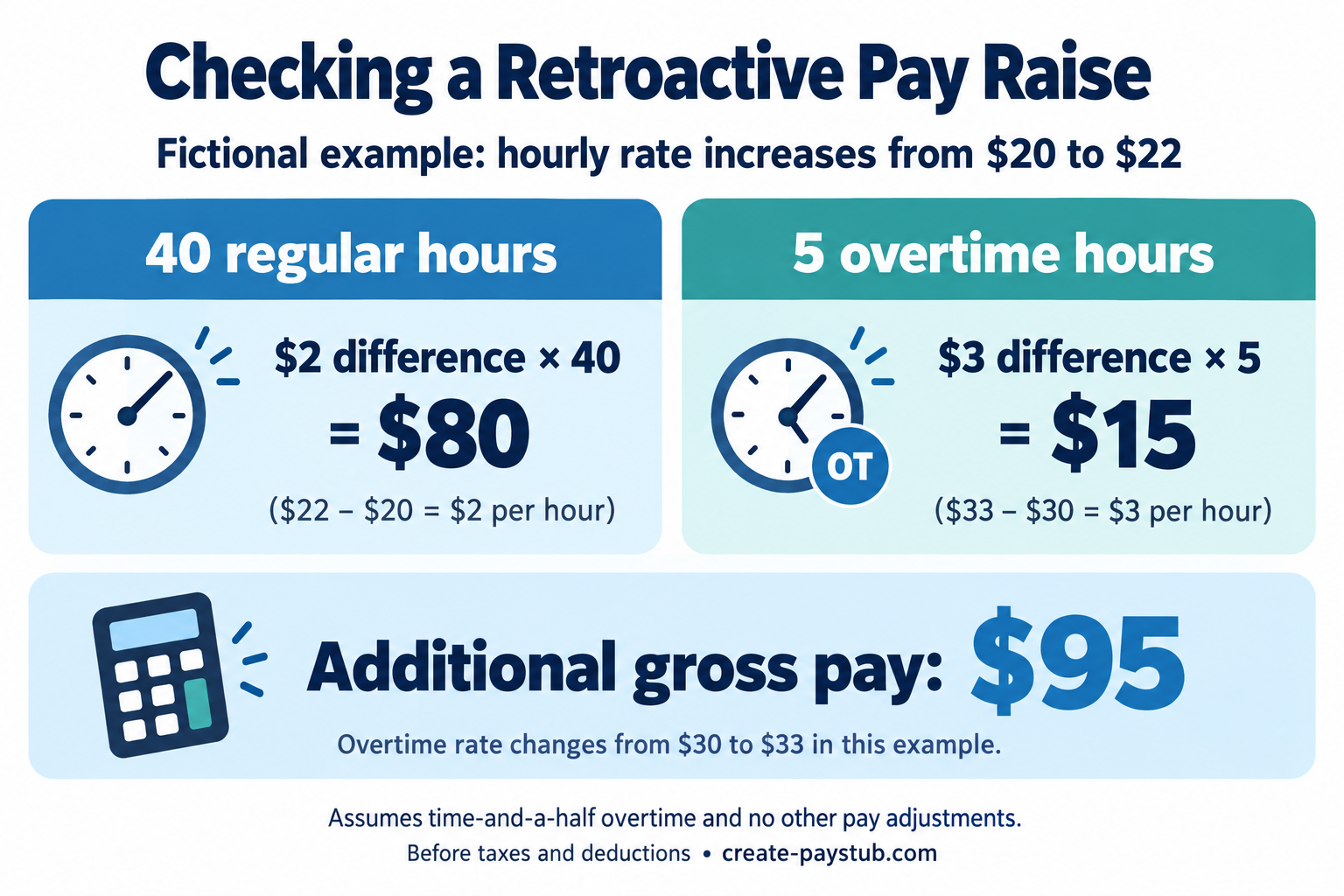
Assume a fictional covered, nonexempt hourly employee worked 40 regular hours and 5 overtime hours in one affected workweek. The original rate was $20 per hour, but an approved raise makes the rate $22 for that entire week. Assume time-and-a-half overtime, that the base rate equals the regular rate for this example, and no bonuses, differentials, or other adjustments.
- Regular-hour difference: $22 − $20 = $2 per hour. For 40 hours, the additional amount is $80.
- Overtime-rate difference: the old overtime rate was $30 and the new rate is $33. For 5 hours, the additional amount is $15.
- Total additional gross pay: $80 + $15 = $95.
A second way to check the arithmetic is to compare the two full gross amounts. Original pay was (40 × $20) + (5 × $30) = $950. Revised pay is (40 × $22) + (5 × $33) = $1,045. The difference is $95. The adjustment is the difference, not another payment of the entire $1,045 if the original $950 was already paid.
Why overtime needs its own check
The Department of Labor's Field Operations Handbook, section 32j07, explains that retroactive increases for services must be included in the regular-rate calculation and allocated to the prior weeks they concern. In the simplified example above, multiplying all 45 hours by only the $2 base-rate difference would give $90 and miss $5 of the overtime adjustment.
Do not apply this example mechanically to multiple rates, bonuses, lump-sum increases, or other overtime arrangements. Ask payroll to explain the regular-rate calculation for each affected workweek. Our biweekly overtime guide explains why checking separate workweeks matters.
Why your deposit may not increase by the gross adjustment
IRS Publication 15 states that back pay, including retroactive wage increases, is taxed as ordinary wages in the year paid. It also includes retroactive increases among supplemental wages; the withholding method depends on the applicable payment circumstances.
Consequently, the $95 gross adjustment in this example is not a promised $95 increase in take-home pay. Review the actual tax and deduction entries and any separate payment. Do not subtract a guessed percentage or assume one withholding rate applies to every adjustment. For the distinction between withholding and final tax, see our supplemental-pay withholding example.
What to ask payroll before accepting the total
- Confirm the effective date and every affected workweek.
- Match the original paid hours and rates to the original statements.
- Request separate regular-pay and overtime adjustments where applicable.
- Identify amounts already corrected, so the same adjustment is not counted twice.
- Match the additional gross amount to the statement and reconcile the resulting payment separately.
A useful request is: “My rate changed from [old rate] to [new rate], effective [date]. Please provide the workweeks, hours, rates, and any overtime adjustments included in the retroactive payment of [amount], and identify any earlier corrections.”
Keep the original statements, rate-change notice, calculation, and revised record together. If the explanation still does not reconcile, use our pay stub correction checklist to document the discrepancy. This example helps review the arithmetic; it does not decide entitlement, payment deadlines, or the rules for every employment arrangement.