
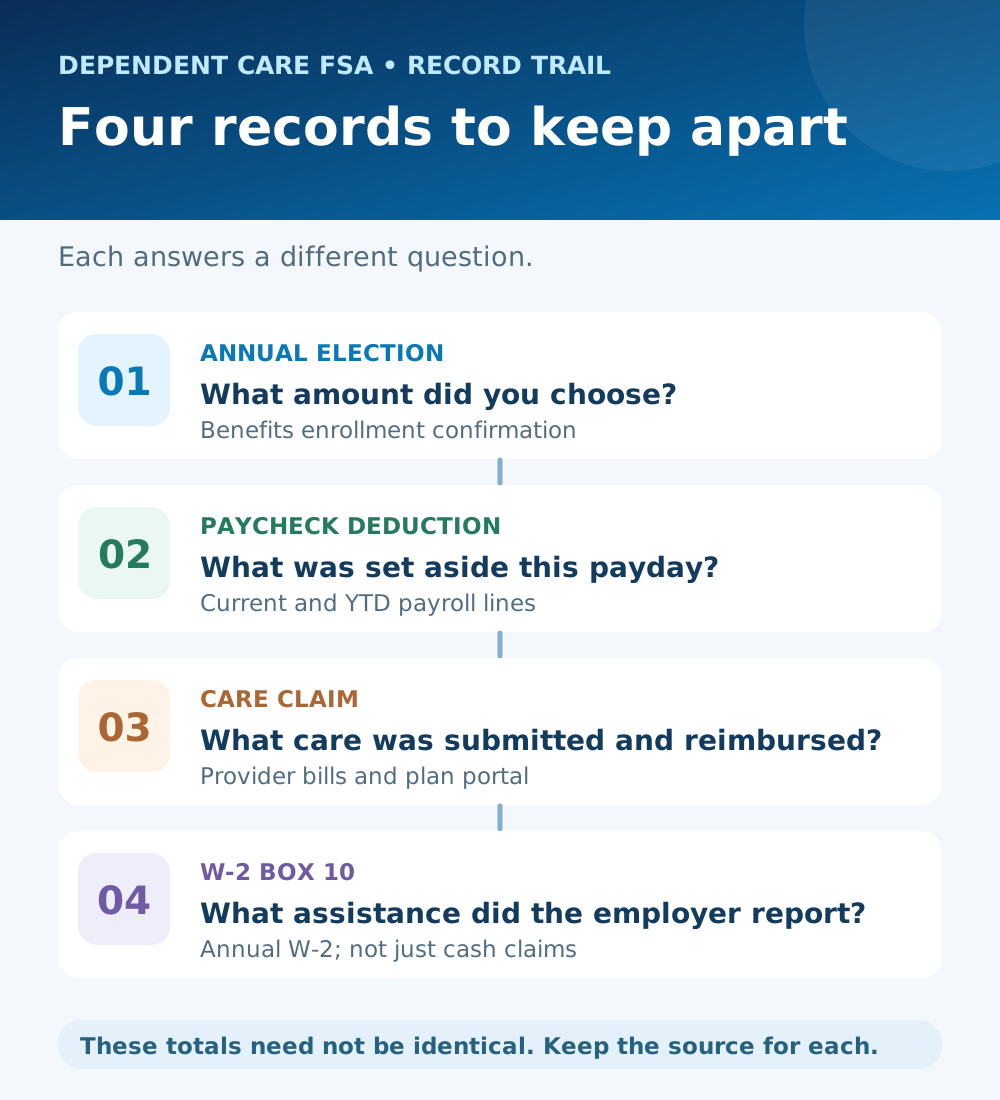
A dependent care FSA line on a pay stub usually shows part of the employee's elected pay being set aside under an employer's dependent care assistance plan. It is meant for qualifying care that allows the employee (and, where relevant, their spouse) to work. The payroll deduction, the care expense, the amount reimbursed, and the year-end W-2 amount are different records; comparing them as if they were the same number can make a correct pay stub look wrong. For 2026, the federal dependent-care exclusion ceiling increased to $7,500 ($3,750 if married filing separately), but your employer's plan and your qualifying circumstances still matter. The IRS 2026 employer guide explains the new ceiling and the exclusion rules.

What the deduction means on a paycheck
Your employer's payroll system may label the line “dependent care FSA,” “DCFSA,” “dependent care,” or something else. Confirm the plan name in your benefits enrollment record; an abbreviation alone does not establish how the money is treated. In a qualifying plan, the elected amount is generally taken from pay before federal income-tax and Social Security/Medicare calculations. The IRS fringe-benefits guide explains that qualified dependent care assistance is excluded from those federal taxes up to applicable limits. State treatment and your other payroll deductions can differ, so the FSA line by itself does not tell you your net pay or exact tax savings.
This is a benefit election, not a government tax or a direct payment to a care provider on every payday. For a broader view of earnings and deductions, see our check-stub reading guide. Our HSA guide covers a separate account used for eligible medical costs; an HSA deduction is not a dependent-care FSA contribution.
The 2026 limit: a ceiling, not an automatic election
IRS Publication 15-B for 2026 states that an employee can generally exclude up to $7,500 of dependent care assistance from gross income, or $3,750 if married filing separately. The exclusion also cannot exceed the smaller of the employee's or spouse's earned income, with special rules for a spouse who is a student or unable to care for themselves. Eligible expenses and plan requirements can limit the usable amount further. Ask your benefits administrator what your employer's written plan actually permits; the federal maximum does not mean every employee should elect that much.
Some older guidance still says $5,000. The IRS has posted a specific correction to its 2026 W-2 instructions: the maximum federal exclusion rose to $7,500 beginning in 2026. Use the corrected figure for 2026 questions, not the old amount from a 2025 pay record or an uncorrected instruction. If both spouses have access to dependent-care benefits, coordinate their elections and household care expenses rather than treating the ceiling as an amount for each child.
Worked example: check the current and YTD deduction
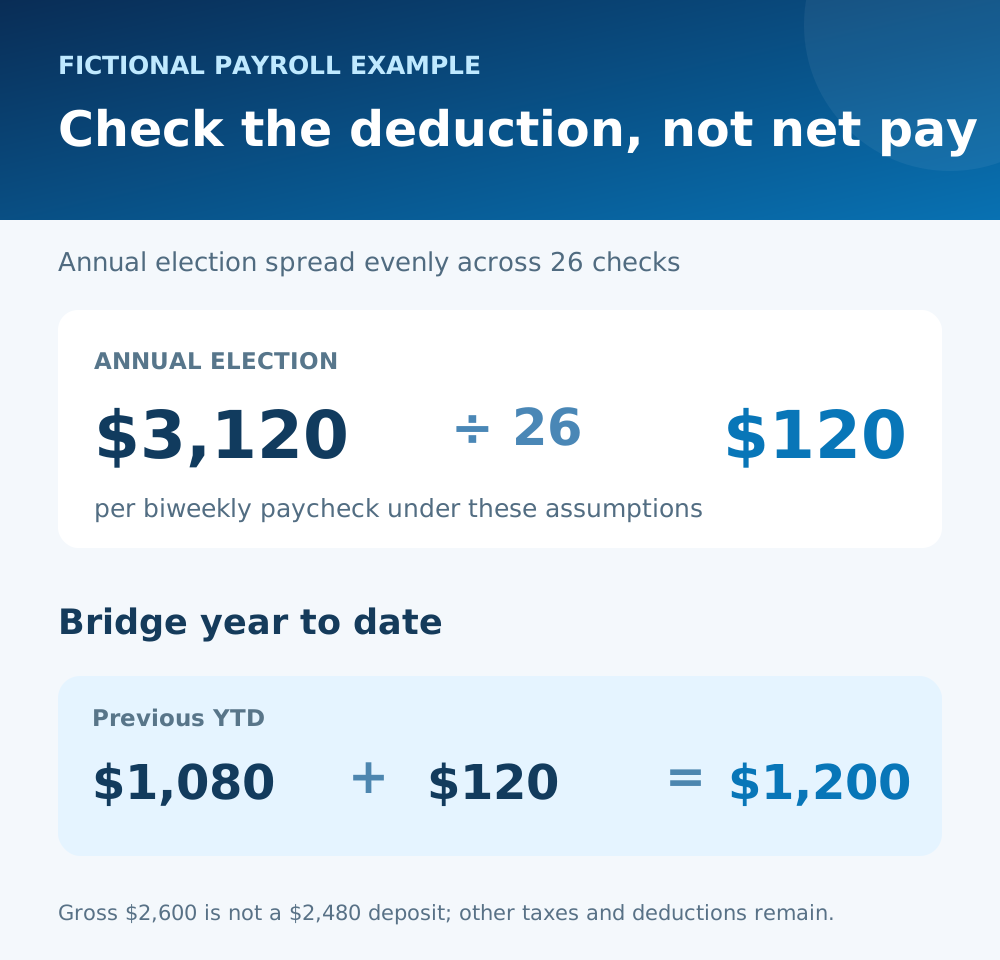
Assume a fictional employee elected $3,120 for a calendar-year plan and has 26 equally sized biweekly payroll deductions. The per-paycheck election is $3,120 ÷ 26 = $120. If the previous stub showed nine $120 deductions, its year-to-date dependent-care FSA total would be $1,080; after the tenth $120 deduction, the new YTD total would be $1,200. If the current gross earnings are $2,600, the $120 benefit line is one part of the payroll calculation. It does not mean the bank deposit is $2,480; taxes and other deductions still have to be accounted for.
Use the previous statement's YTD balance as the starting point. The current statement's YTD total generally already includes the current deduction. Our YTD guide shows how to avoid counting one pay period twice. In real payroll, an election change, skipped check, employer contribution, or plan-year timing can change the simple pattern; compare the election confirmation and plan portal as well as the stub.
Which care expenses can the plan reimburse?
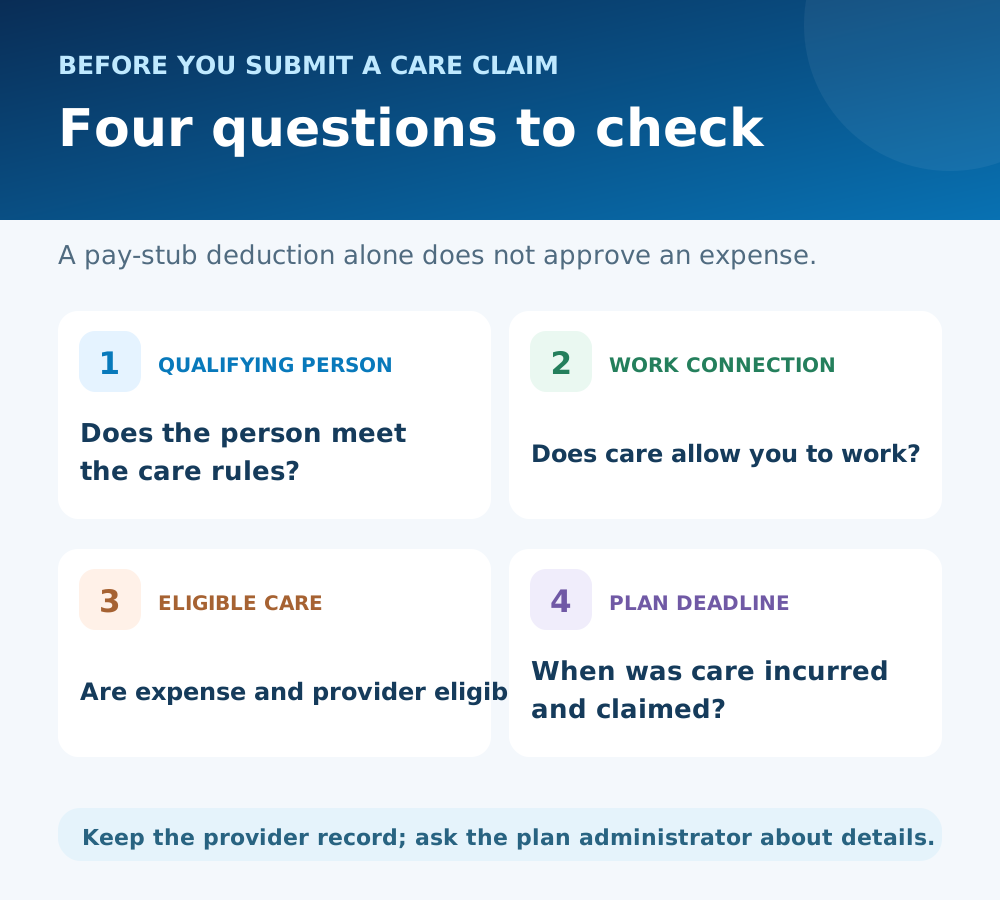
The core test is care for a qualifying person so you can work or look for work, subject to the plan's rules and federal requirements. IRS Publication 15-B points to the same work-related-care tests used for the child and dependent care credit. The IRS's care-expense guidance discusses examples such as care for a child under 13, and care for a spouse or dependent unable to care for themselves. Preschool and before- or after-school care can qualify when they are primarily care; kindergarten tuition and overnight camp generally do not. Eligibility depends on the individual, provider, expense, and dates, so check the current plan document before submitting a claim.
Keep the provider's identity, dates of care, amount charged, payment evidence, and any claim decision. A payroll deduction only shows that money was allocated under the plan; it does not prove that a later expense was qualified or reimbursed. The currently available IRS Publication 503, written for 2025 returns, explains the no-double-counting rule for reimbursed care expenses. Check the instructions for your actual filing year when preparing the return.
What happens to unused money or a mid-year election?
Do not assume a dependent-care FSA behaves like a health FSA or HSA. Dependent-care arrangements generally have a use-or-lose rule, but an employer's cafeteria plan may offer a grace period of up to two months and 15 days after the plan year for eligible expenses. It is optional and must be in the plan; a claim-submission deadline is a separate date from the period when care can be incurred. Ask for both dates in writing. An employer's plan also controls whether a mid-year election change is allowed under applicable rules. Do not rely on a general blog example to decide when to stop payroll deductions.
How the FSA connects to W-2 Box 10 and Form 2441
At year-end, your employer reports dependent care assistance in Form W-2 Box 10. The 2026 IRS employer guide says Box 10 includes both the nontaxable portion and any assistance above the exclusion that is taxable and also reported in wages. The IRS correction says amounts paid or incurred are reported regardless of employee forfeitures. Box 10 therefore may not equal cash reimbursement received or a simple total of deductions if your employer provided other assistance or there was a plan adjustment.
When filing, Form 2441 is used to determine how much dependent-care assistance can be excluded and to coordinate any child and dependent care credit. Do not claim the same expense twice. If your final pay-stub YTD amount and W-2 Box 10 differ, ask payroll to identify employee deductions, employer-funded care, adjustments, and any taxable excess before changing a return or assuming either document is wrong. Our W-2 versus pay-stub guide explains the broader differences among annual wage boxes.
A five-part check when the amount looks wrong
- Confirm the plan. Match the payroll label with the benefits enrollment confirmation and annual election.
- Check the pay period. Divide the election by the actual number of scheduled deductions; confirm changes, unpaid periods, and rounding with payroll.
- Bridge YTD carefully. Prior YTD plus this period's deduction should explain current YTD unless an adjustment occurred.
- Keep claims separate. Compare provider bills and reimbursements in the plan portal; a deduction is not itself a paid claim.
- Reconcile year-end reporting. Ask payroll for the components of W-2 Box 10 and consult the current Form 2441 instructions for your filing situation.
If an employer-issued stub contains a real error, request a payroll correction rather than editing the document yourself. Our pay-stub correction checklist offers a way to record the discrepancy and review the replacement statement.