
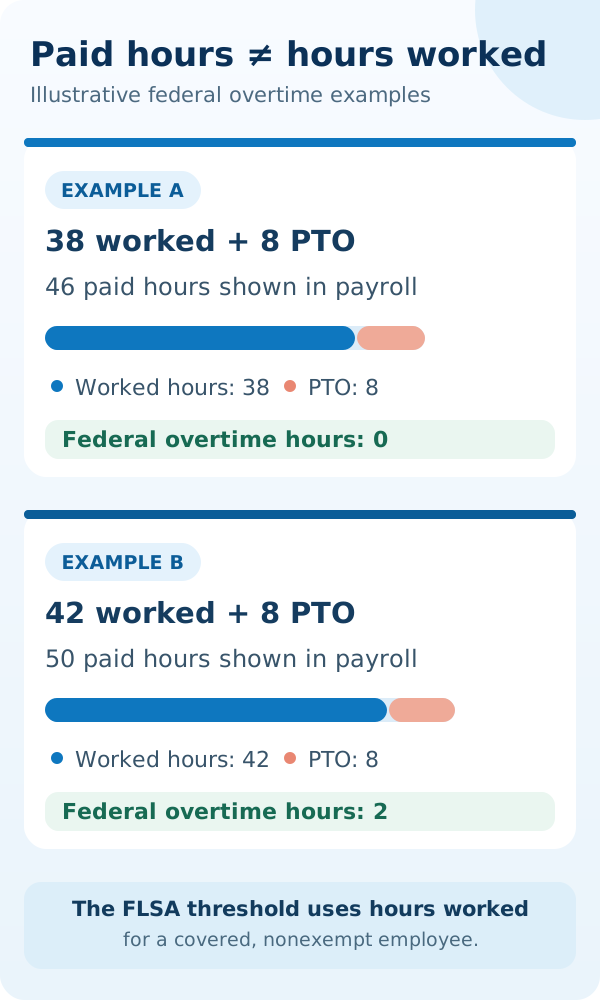
Paid time off (PTO) usually does not count as hours worked when calculating overtime under the federal Fair Labor Standards Act (FLSA). You can be paid for 46 hours in a week—38 hours worked plus 8 hours of PTO—and still have no federal overtime hours. For a covered, nonexempt employee, the federal overtime threshold is more than 40 hours actually worked in one workweek. The U.S. Department of Labor’s FLSA FAQ ties overtime to hours worked and describes vacation, sick, and holiday pay as payment for time not worked.
That is the federal baseline, not a universal description of every paycheck. A state rule, union agreement, or employer policy may provide a more generous result. First separate worked hours from paid-leave hours; then check the rule that applies to your job.

What counts toward the federal overtime threshold?
The FLSA generally requires overtime of at least one and one-half times the regular rate for a covered, nonexempt employee’s hours worked beyond 40 in a workweek. A workweek is a fixed, recurring seven-day period; it need not match the calendar week. The Department of Labor’s overtime guidance also says employers generally cannot average hours across two workweeks to avoid overtime.
“PTO hours” on a stub are commonly hours paid for time away from work under an employer’s leave program. If you did not work those hours, they are not federal FLSA hours worked merely because they were paid. Vacation, paid sick leave, and a paid holiday off follow the same federal hours-worked distinction. By contrast, time you actually work on a holiday or on a day originally scheduled as PTO counts as work time, even if the calendar also labels it a holiday or leave day. The Department of Labor’s overtime page explains that federal overtime is based on hours worked, including work on a holiday when the weekly threshold is reached.
Also separate accruing PTO from using it. A balance that increased this pay period is a leave record, not extra hours you worked. Our PTO-balance guide explains accrued, used, and available amounts.
Two fictional weeks: 46 and 50 paid hours
Assume an hourly, covered nonexempt employee earns $20 per hour, receives PTO at $20 per hour, and has no other pay that changes the overtime regular rate. These figures are fictional and show the basic federal calculation; they do not determine the result under every state law or pay plan.
In Example A, pay for work is 38 × $20 = $760 and PTO pay is 8 × $20 = $160. Gross earnings from these two lines total $920. Although 46 hours are paid, only 38 were worked, so the example has no FLSA overtime hours.
In Example B, the first 40 worked hours pay $800, the two overtime hours pay 2 × $30 = $60, and the eight PTO hours pay $160. Gross earnings from these lines total $1,020. Here the overtime comes from 42 worked hours, not from adding PTO to the threshold. Another way to check the work portion is 42 × $20 plus an extra half-rate premium of 2 × $10: both methods give $860 for worked time, before the $160 PTO line.
These simple calculations assume a fixed hourly rate and no extra compensation affecting the regular rate. Bonuses, different hourly rates, and certain premiums can change an actual overtime calculation. Compare the real payroll record rather than applying the example mechanically.
How to read the PTO and overtime lines on a pay stub
- Find the pay period and workweek boundaries. A pay period may contain more than one workweek. You need the employer’s workweek to test the federal 40-hour threshold.
- Separate worked time from paid leave. Look for regular, overtime, vacation, sick, holiday, or PTO codes. A total-hours-paid field may combine worked and leave hours, so it may not be the overtime test by itself.
- Compare with your time record. Check clock-in data, approved leave, and any actual work performed on the leave day. An unpaid, duty-free meal break is normally different from paid work time; our unpaid lunch-break guide helps with that check.
- Check both hours and dollars. If the time record shows overtime-eligible worked hours, verify that the statement has the appropriate overtime pay or adjustment. Do not confuse a PTO payment with an overtime premium.
Payroll labels vary. A stub might show “regular 38,” “PTO 8,” and “OT 0,” or it might show one total-hours field plus separate earning lines. The code itself does not establish the legal treatment; the work performed and the applicable rules do.
What if the stub covers two weeks?
Do not add two weeks together and test against 80 hours for ordinary FLSA overtime. Each fixed workweek stands alone. Suppose a biweekly statement covers a first week with 38 worked hours plus 8 paid PTO hours, and a second week with 42 worked hours. The first week has no federal overtime; the second has two federal overtime hours. The combined 80 worked hours are not the way to decide whether either week had overtime.
A pay stub may aggregate both weeks into one line, which makes the result hard to check without the timecard. Ask payroll for the week-by-week breakdown if needed. Our biweekly overtime guide explains that reconciliation step in detail.
When state law or employer policy changes the answer
Some employers voluntarily count paid leave toward an internal overtime or premium-pay eligibility rule. A collective bargaining agreement or employment policy may also promise benefits above the FLSA floor. Read the exact policy: it may distinguish vacation from sick leave, or specify a premium triggered by paid hours rather than worked hours. A more generous policy does not change the separate federal hours-worked definition; it can create an additional entitlement under that policy.
State overtime rules can also differ. For example, California generally has daily as well as weekly overtime rules for many nonexempt employees, subject to exemptions and exceptions. Its Labor Commissioner also gives an example in which paid sick or holiday time did not count as hours actually worked for overtime. A California employee therefore needs to check the actual daily and weekly work hours, not simply the paid-hour total. Other states and occupations may have different rules; use current state guidance for your situation.
If you are classified as overtime-exempt, the ordinary FLSA 40-hour premium test may not apply to your role. Ask payroll which classification and policy govern your pay instead of assuming the same calculation as an hourly nonexempt worker.
Common questions
Does paid sick leave count toward overtime?
Under the federal FLSA, paid sick time off is not hours worked merely because it is paid. Actual work performed while marked out sick is a different question and should be recorded accurately. Check state law and employer policy for any more generous benefit.
Does a paid holiday count toward overtime?
A paid holiday off generally does not add FLSA hours worked. Hours actually worked on the holiday do count as worked time. A holiday premium may be due under a policy, agreement, or applicable state rule even when federal overtime is not.
Can my employer pay overtime after 40 paid hours anyway?
Yes. An employer can adopt a more generous premium rule. Check the written policy or agreement and how payroll applies it; do not confuse that policy benefit with the minimum federal overtime requirement.
Does using PTO reduce overtime already earned from work?
No. Paid leave does not erase actual hours worked in that workweek. If you worked more than 40 FLSA hours in the week, the covered nonexempt hours above 40 still need the required overtime treatment. The employer may need to correct the PTO entry if it overlaps with time you actually worked.
A focused question to send payroll
If the stub seems inconsistent, ask: “For the workweek of [dates], I show [X] hours actually worked and [Y] PTO hours. Which hours did payroll use for the overtime calculation, and does a state rule or our policy change that result?” Attach the relevant timecard and leave approval through your employer’s secure channel. A clear week-by-week question helps payroll check the correct threshold, rate, and leave entry.
If the answer reveals an error, keep the original statement and request a corrected payroll record. Our pay-stub correction checklist covers the next steps.