
A holiday entry can increase the paid hours on your pay stub without increasing the hours counted toward federal overtime. The first question is whether the entry represents time you worked on a holiday or paid time off for the holiday. Those are different things to check when reconciling your pay.
What does holiday pay mean on a pay stub?
Start with the employer's earnings-code definitions. A label such as “HOL” alone does not tell you whether the payment is for a day off, work performed, or an additional premium. Ask payroll to identify the code before treating it as an error.
- Paid holiday time off: compensation for an eligible holiday when you did not work.
- Work performed on a holiday: wages for time you actually worked that day.
- Holiday premium: additional compensation under a policy or agreement, if applicable. Check whether the displayed rate includes the premium or whether the premium is listed separately.
Read the hours, rate, and current earnings together. Keep year-to-date amounts separate from this payment's figures. Our guide to reading a check stub explains that distinction.
Does holiday pay count toward overtime?
For covered, nonexempt employees under the ordinary federal FLSA rule, overtime applies after 40 hours worked in a workweek, at no less than one and a half times the regular rate. The workweek is the relevant unit; do not simply add both weeks of a biweekly paycheck together. See the Department of Labor's overtime fact sheet and our biweekly pay stub overtime guide.
The Department's Hours Worked Advisor explains that paid holiday time off need not count as hours worked for federal overtime. Hours actually worked on a holiday do count as work. A holiday date alone does not create a federal double-time entitlement. Other applicable rules or a more generous employment agreement may change what you receive.
Why 48 paid hours can mean no federal overtime
These fictional examples assume a covered, nonexempt employee, one workweek, the ordinary federal overtime rule, and an employer that pays eight holiday hours off but does not count that leave toward its overtime threshold.
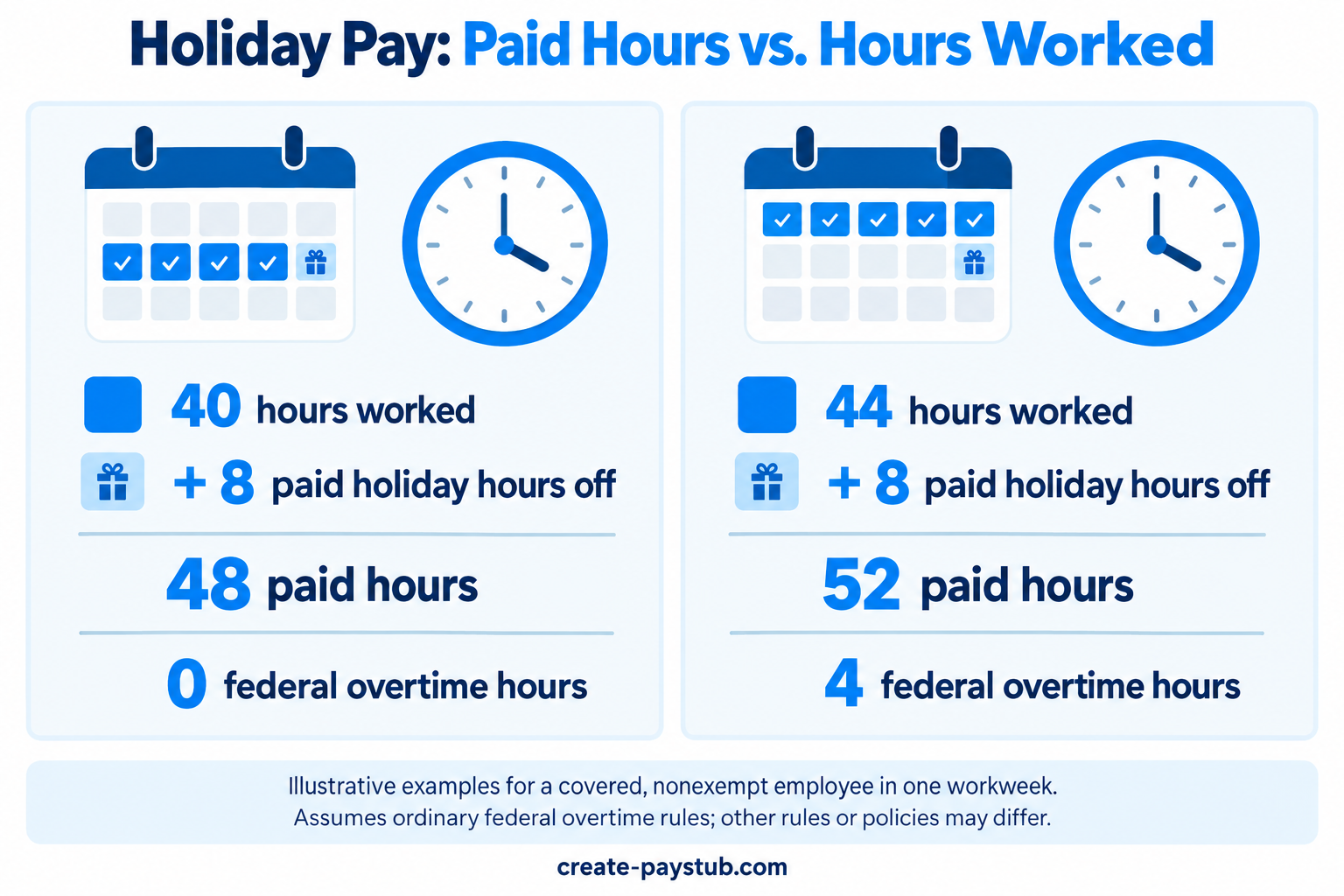
- Example A: 40 hours worked + 8 paid holiday hours off = 48 paid hours. Worked hours do not exceed 40, so there are zero federal overtime hours under these assumptions.
- Example B: 44 hours worked + 8 paid holiday hours off = 52 paid hours. Four worked hours exceed 40, so four hours qualify for federal overtime under these assumptions.
The examples compare hours, not net pay or tax withholding. They also do not calculate how a separate holiday premium affects an overtime payment. Ask payroll to explain that calculation if your statement includes both a premium and overtime.
Is paid holiday leave required?
The FLSA itself does not require wages for holiday time not worked. The Department of Labor's holiday benefits guidance says those benefits generally depend on the employment agreement and identifies separate requirements for certain government contracts.
That federal baseline does not answer every question about your entitlement. Check the applicable state or local rules, any collective bargaining agreement, and the employer's written holiday policy. Confirm the eligibility conditions, the holiday schedule, and the number of paid hours promised before comparing the statement with your expectations.
How to check a missing or confusing holiday entry
- Match the dates. Confirm that the holiday falls within the statement's pay period. The deposit date is not the start or end of the work period.
- Separate work from leave. Use your time record to list actual work hours and paid time off by workweek.
- Read the policy. Find the provision that describes your holiday benefit and any premium for working.
- Reconcile the earnings lines. Check whether the holiday amount appears separately or is included in another entry. Avoid adding an included premium twice.
- Request an explanation or correction. Keep the original pay stub, time record, and payroll response together.
A useful message to payroll is: “For the pay period ending [date], I recorded [hours] worked and expected [hours] of paid holiday leave under [policy]. The statement shows [code and amount]. Can you explain the code and how these hours were treated for overtime?”
If you believe required wages remain unpaid after checking the records, contact the relevant labor agency or a qualified adviser about your circumstances. This article is an educational reading guide, not a determination of an individual wage claim.