
Post-tax deductions on a pay stub, also called after-tax deductions, reduce the cash you take home without themselves reducing the wages used to calculate payroll taxes. A designated Roth 401(k) employee contribution is one example: the money goes into the retirement account, but it remains included in current income. The IRS designated Roth account guidance explains that treatment.
To check an unfamiliar deduction, trace two effects separately: Does this line change a taxable wage total? and Does it reduce the cash payment? A third question—whether it can qualify for a deduction on your tax return—depends on the underlying expense and the filing rules, not simply on payroll calling it “post-tax.” This guide focuses on reading U.S. employee payroll records, with federal tax treatment distinguished from plan-specific and state rules.
Start by identifying what the line actually does
“Post-tax” describes a tax treatment, not a standard payroll code, a government charge, or a guarantee that a deduction is authorized. Confirm the full description in your employer's payroll portal and compare it with your benefit election, retirement election, agreement, or applicable order. Do not classify it solely by where it appears on the printed statement.
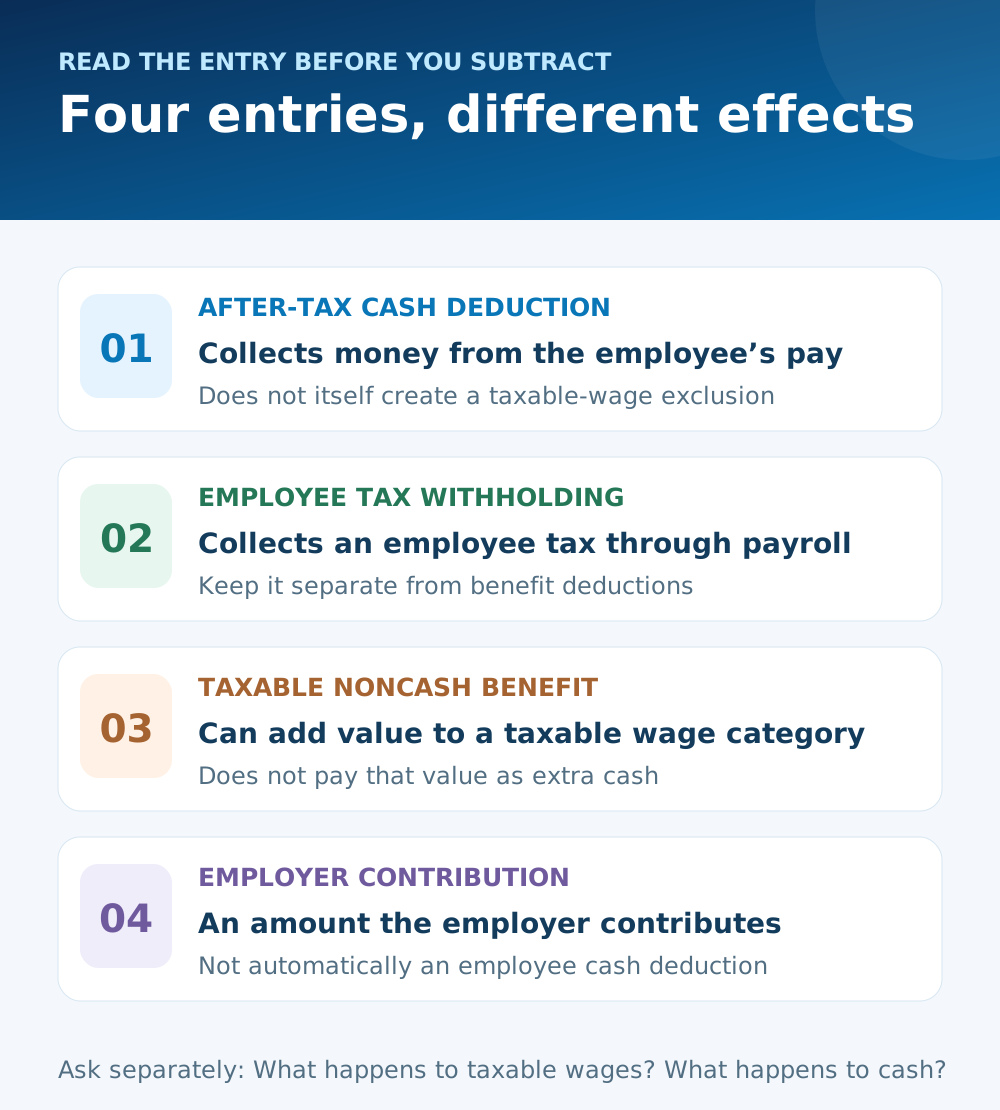
Keep these types of entries separate:
- A cash deduction: money collected from your pay for a benefit, payment, or other obligation. A confirmed after-tax employee premium reduces the cash payment but does not create a payroll wage exclusion merely because it was deducted.
- Tax withholding: an employee tax amount, such as federal income tax or Medicare, collected through payroll. It is a different category from an after-tax benefit deduction. Our FIT versus FICA guide explains the main tax lines.
- A taxable noncash benefit: a value included in a wage category even though the employer is not paying that value as cash. It can affect taxes without being an employee premium.
- An employer contribution: an amount the employer contributes or displays for information. Do not subtract it from employee net pay unless payroll confirms a separate employee charge.
Why “pre-tax” does not mean exempt from every tax
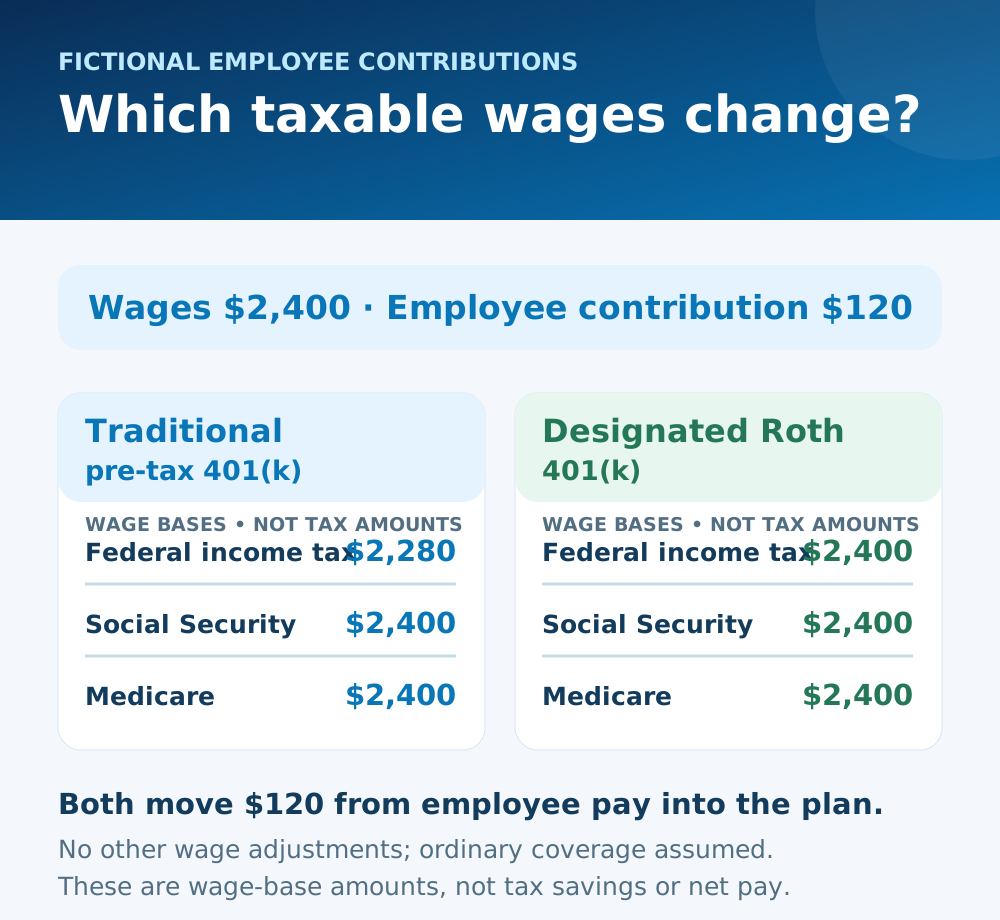
A pre-tax deduction can reduce one wage category while leaving another unchanged. For a traditional pre-tax employee 401(k) deferral, the IRS 401(k) explanation says deferred wages generally are excluded from current federal income-tax withholding but remain subject to Social Security and Medicare. An employee Roth deferral generally remains subject to all three. See the IRS contribution withholding comparison.
For example, assume $2,400 of wages and a $120 employee contribution, with no other wage adjustments and ordinary coverage. A traditional pre-tax 401(k) deferral would leave $2,280 of federal income-tax wages; the Social Security and Medicare wage amounts would remain $2,400 before applying their other rules. A designated Roth contribution would leave all three wage amounts at $2,400. Both direct $120 from the employee's pay into the plan. These are wage-base figures, not a calculation of tax saved or net pay.
Benefit rules can be different from retirement rules. IRS Publication 15-B explains qualified benefits available through written cafeteria plans and the applicable exclusions. A line labeled “medical,” “insurance,” or “FSA” is not enough to establish every tax consequence. Ask which plan and exclusion apply, and which federal, state, or local wage bases payroll adjusts. Our 401(k) deduction guide covers retirement elections in more detail.
Worked example: reconcile a paycheck with two after-tax deductions
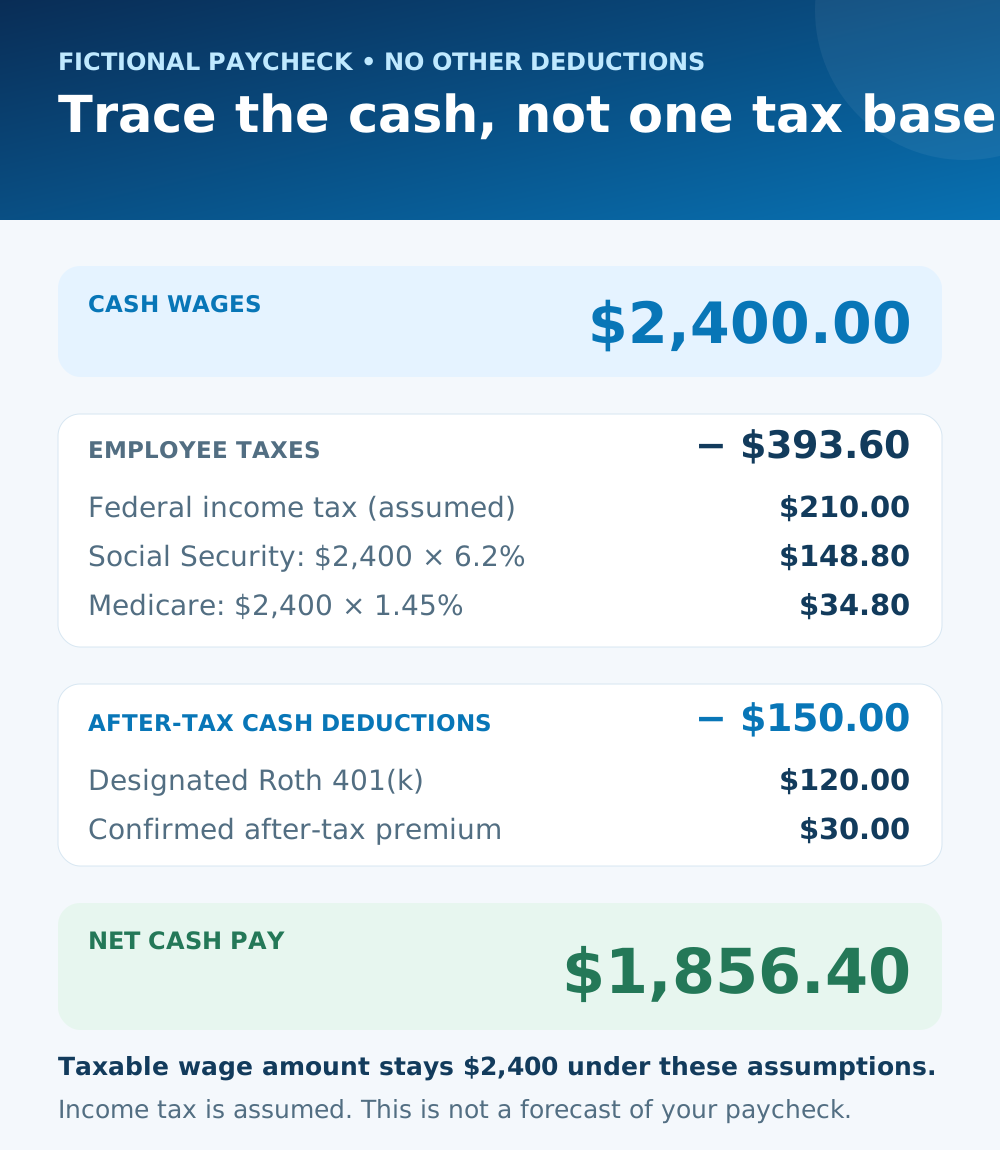
Assume a fictional employee earns $2,400 in cash wages, all subject to the standard employee Social Security and Medicare taxes. The employee is below the Social Security wage limit, has no Additional Medicare Tax, no pre-tax deductions, no taxable noncash benefits, and no state or local withholding in this illustration. Federal income-tax withholding is assumed to be $210; it has not been calculated from a W-4 or tax table.
The confirmed after-tax cash deductions are a $120 designated Roth 401(k) contribution and a $30 employee insurance premium. The premium's after-tax classification is an assumption for this example, not a rule for all insurance plans.
- Employee Social Security: $2,400 × 6.2% = $148.80.
- Employee Medicare: $2,400 × 1.45% = $34.80.
- Total employee tax withholding: $210 + $148.80 + $34.80 = $393.60.
- Total after-tax cash deductions: $120 + $30 = $150.00.
- Net cash pay: $2,400 − $393.60 − $150 = $1,856.40.
The standard federal payroll rates are described in IRS Topic 751. The two after-tax deductions did not turn the $2,400 taxable wage amount into $2,250. They reduced the cash available after the tax calculation. Subtracting them from the taxable wage base and then from net pay would apply the wrong treatment.
“After tax” is a way to describe the calculation's tax treatment; it does not mean payroll must physically make separate transfers in this exact sequence. Use the wage categories and deduction totals, rather than the order in which rows are printed. If the deposit does not equal the statement's net pay, check payment allocations separately with our direct-deposit reconciliation guide.
Check insurance values and after-tax retirement codes carefully
A group-term life insurance code deserves a closer look. Publication 15-B describes taxable costs for certain employer-provided coverage above $50,000. That is a benefit valuation rule; it does not make the entire coverage amount a cash deduction. A statement can show taxable benefit value, an employee premium, or a noncash offset, and those entries do different jobs. Ask payroll to explain the valuation and any cash charge separately. Our imputed-income guide shows how noncash entries can affect the statement.
Also, “after-tax retirement” does not always mean designated Roth. The IRS withholding comparison distinguishes ordinary employee after-tax contributions from designated Roth contributions. Confirm the contribution type in the plan records. Do not infer withdrawal rules, account eligibility, or tax-free earnings from an abbreviation on a pay stub.
What changes—and what does not—on the W-2
A cash deduction and a wage exclusion are different. The 2026 W-2 instructions require designated Roth 401(k) contributions to be reported in box 12 using code AA, while those wages generally remain in boxes 1, 3, and 5, subject to their reporting rules. Other plan types use different codes; not every after-tax cash deduction has its own standard W-2 box.
In the fictional example, do not reduce federal taxable wages by $150 simply to make them equal cash left before taxes. Likewise, do not subtract the annual Roth amount from W-2 box 1 just because it appears separately in box 12. Box 1 is an annual wage category, not the total deposited in your account. Our W-2 wage reconciliation guide explains how to compare like categories.
The “post-tax” label also does not create an automatic income-tax deduction or refund. Whether the underlying expense qualifies on a return depends on that expense, the applicable year, and your circumstances. A Roth contribution's treatment, an insurance payment's treatment, and a charitable payment's treatment should not be assumed identical. Keep supporting records and use the relevant filing instructions when that question arises.
Can you change or stop the deduction?
First identify its basis. An elected benefit or employee contribution follows its plan or agreement and effective-date process. Ask the administrator when a change can take effect and whether enrollment periods or other restrictions apply. “After-tax” by itself does not establish a right to cancel immediately or confirm that an unfamiliar charge is lawful.
A garnishment or support-related withholding is a different process. The Department of Labor's garnishment guidance explains that voluntary deductions generally do not reduce the disposable earnings used for the federal CCPA calculation. Taking more after-tax deductions therefore is not a general way to reduce a garnishment base. Read the order and ask for its governing calculation; our disposable earnings guide explains why this amount is not the same as final net pay.
A five-part check for an unfamiliar or unexpected amount
- Identify the entry. Request its full description and confirm whether it is an employee cash deduction, tax, noncash value, offset, or employer contribution.
- Match the supporting record. Compare the amount or percentage with the election, coverage period, agreement, or order. Confirm the effective date and number of payroll collections.
- Check each wage category. Ask whether the entry changes federal income-tax, Social Security, Medicare, and any state or local wages. Do not use one “taxable pay” number for every check.
- Reconcile cash once. Add only the current employee deductions that actually reduce this payment. Keep current, YTD, and informational totals separate; check whether detail lines already belong to a displayed total.
- Document the reply. Keep the statement, relevant record, payroll explanation, and any replacement statement. Confirm when an approved correction or election change will appear.
For example, if the prior statement shows $210 YTD for an after-tax premium and this payment adds $30, the new YTD is $240. It is not a further $240 deduction from this check. A later amount that differs needs a check for adjustments or timing, not an assumed explanation.
A focused request can say: “My statement dated [date] shows [code] for [amount]. Please identify the source of the deduction, its effective date, the taxable wage categories it affects, and whether it is already included in the current employee deduction total.” If a genuine error remains, use our pay-stub correction checklist. Request a correction through payroll rather than changing an employer-issued document yourself.